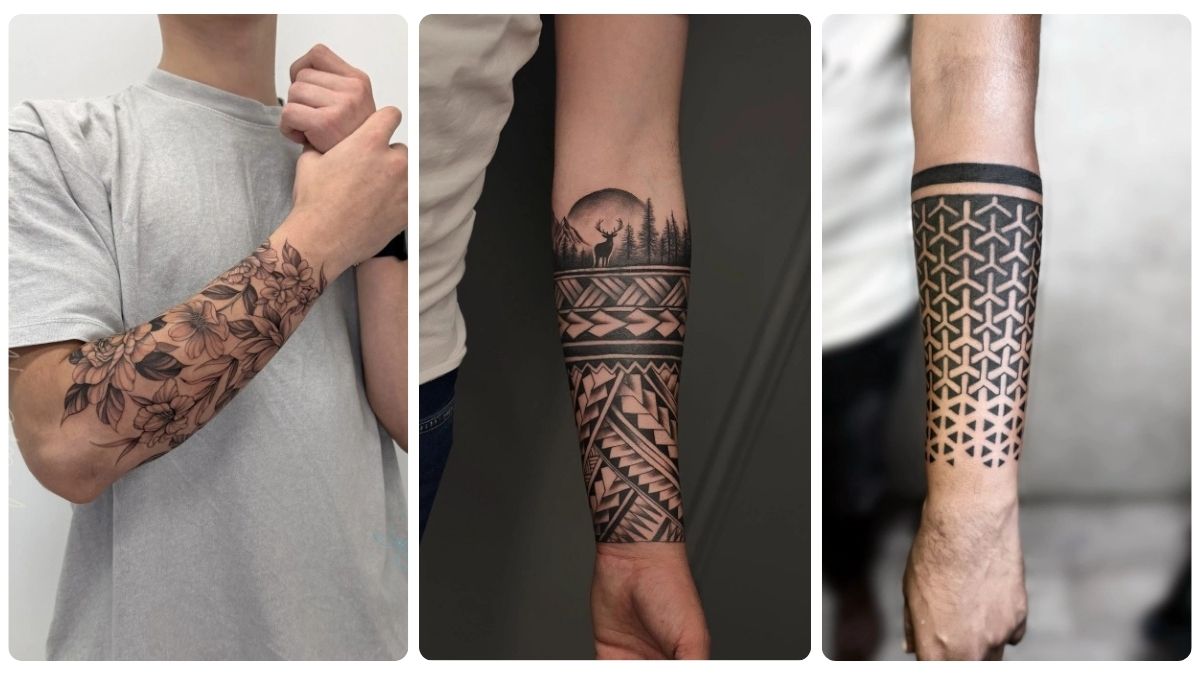
A well-executed half sleeve feels like a tailored piece of armor. Crisp black linework and smooth shading wrap around the bicep, settling naturally into the skin.
Starting at the shoulder gives you room to build a cohesive theme without committing a full limb. Minimalist geometry fits professional environments, while dense traditional flash suits a more rugged look.
Planning the Canvas Ink Strategies for Upper Arms
Treating the bicep and shoulder as a unified space requires an understanding of natural muscle flow. Wrapping a large design around the shoulder cap creates a strong visual anchor.
Smaller filler pieces can bridge gaps later if you prefer a collected look. Dense shading on the outer arm contrasts nicely with softer linework on the sensitive inner bicep.
SLEEVE LOGIC
1. Minimalist Geometric Nature Scene
Fine Line Focus and Negative Space
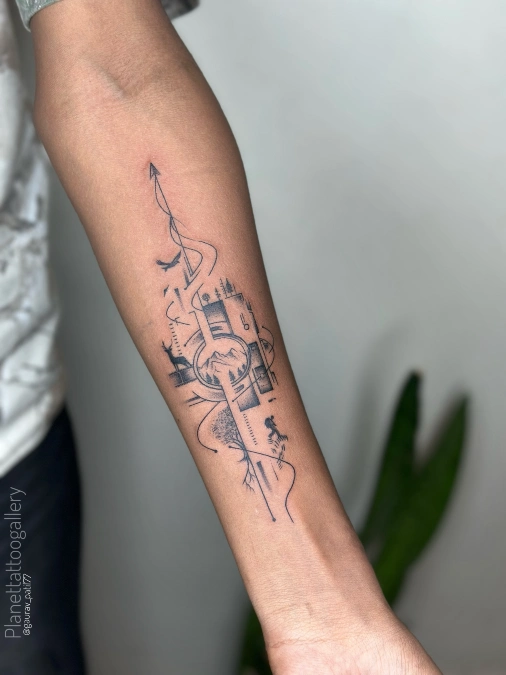
Crisp black lines create a narrow vertical journey down the forearm. Delicate stippling softens the transitions within the central geometric frame. Small, bold silhouettes of wildlife and a hiker provide grounded narrative points against the airy structure.
Mixing fine line details with solid black silhouettes ensures immediate design clarity.
This vertical composition suits long, visible canvases like the forearm or the outer bicep. Its structured design uses the natural flow of the arm to elongate the limb rather than wrapping heavily.
2. Structured Blackwork And Scenic Silhouette
Balancing Heavy Ink And Soft Shading
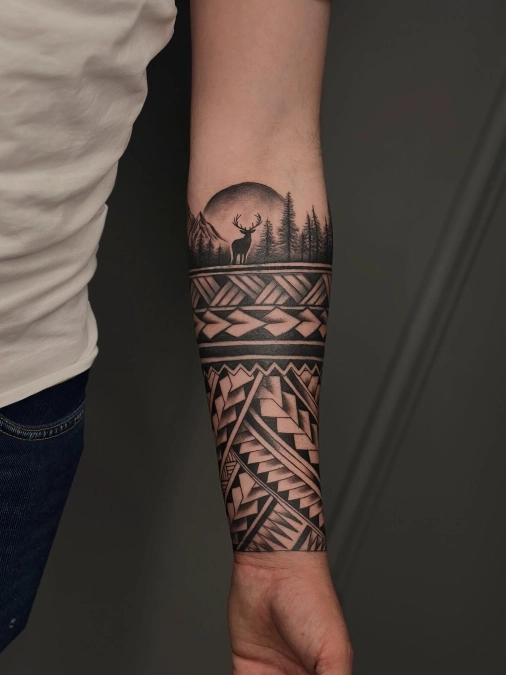
Dense geometric bands anchor the lower arm with heavy black ink. Delicate stippling creates a moody atmospheric forest right above the rigid lines. The crisp silhouette of a stag stands out against a pale shaded moon.
Anchoring organic shapes with structured borders gives heavy tattoos a clean architectural finish.
Wrapping thick geometric bands around the forearm highlights natural muscle contours. Men wanting dense coverage without a chaotic look benefit from these rigid framing lines.
3. High Contrast Realism And Scale
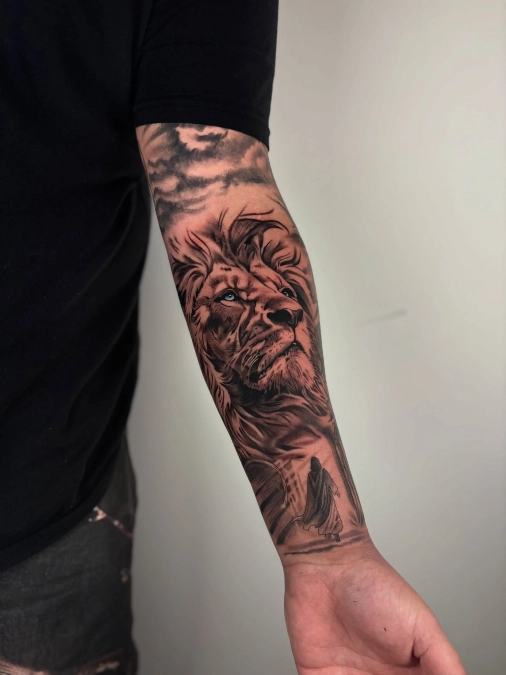
Soft grey shading builds a moody sky right below the elbow. The deeply textured lion mane flows organically down the center of the arm. Sharp black ink defines the lone figure walking near the wrist.
Placing a hyper-realistic focal point in the middle of the arm grounds the entire composition.
Large portraits require a wide, flat canvas like the inner or outer forearm to prevent facial distortion. Adding a smaller landscape at the bottom creates an impressive forced perspective.
Why This Works
Dark atmospheric clouds act as a natural cover to soften the upper arm transition near the joint.
Leaving raw skin exposed between heavy shading gives the thick mane readable depth and texture.
A tiny walking silhouette establishes a massive sense of scale against the giant animal portrait.
4. Vintage Nautical Layering On The Forearm
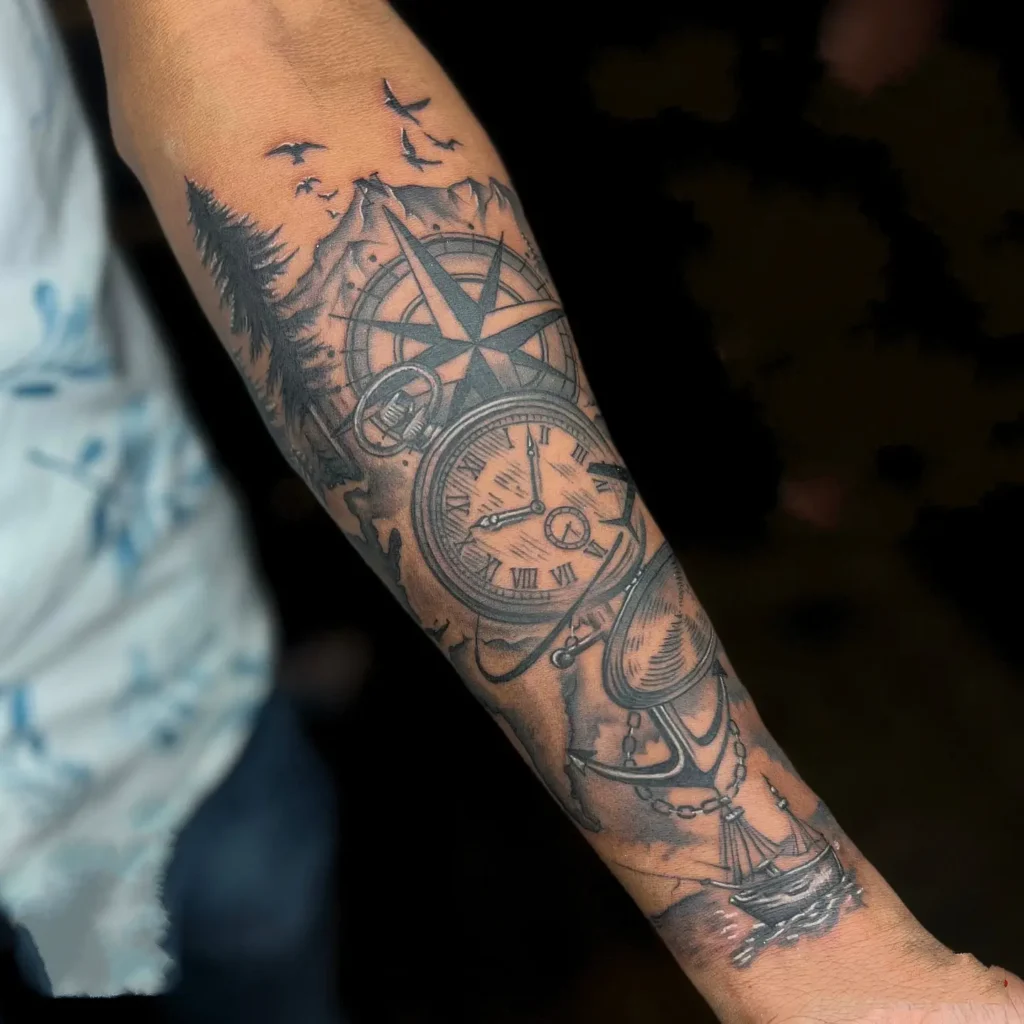
Crisp black shading layers a detailed pocket watch over a rustic ship and heavy anchor. Soft grey clouds blend the rigid edges of the compass into the jagged mountain peaks above. Small flying birds add a light, airy feeling near the top edge.
Layering distinct vintage elements together builds a cohesive story instead of looking like random pieces.
Stacking large circular elements like compasses and watches anchors the center of the arm. You need soft background shading, like the map and clouds, to fill gaps without crowding the main objects.
Quick Styling Tips
Budget version: Start with just the central pocket watch and add the surrounding nautical details over a few years.
Renter tip: Place this heavy design on the upper arm if you need to keep it easily hidden under standard work shirts.
Pro move: Ask your artist to drop in tiny white ink highlights on the watch face glass to make it pop against the heavy dark shading.
5. Cascading Waterfall And Pine Forest Landscape
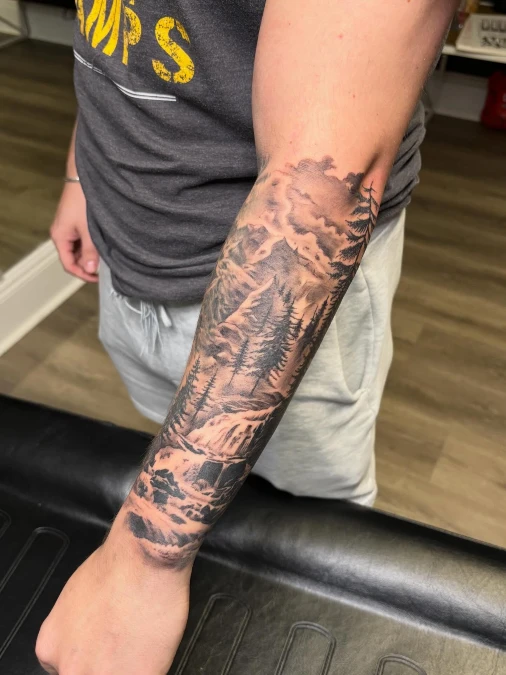
Soft clouds frame the rugged mountain peaks near the elbow joint. Tall pine trees pull the eye downward toward a rushing river. Deep charcoal shading builds rich contrast against the blank skin.
Using negative space to mimic rushing water creates an organic visual flow down the narrow limb.
Full landscape tattoos require a long canvas to let the heavy elements breathe properly. Tapering the waterfall toward the wrist functions just like laying a long runner rug to elongate a narrow hallway.
6. Organic Floral Wrap And Botanical Shading
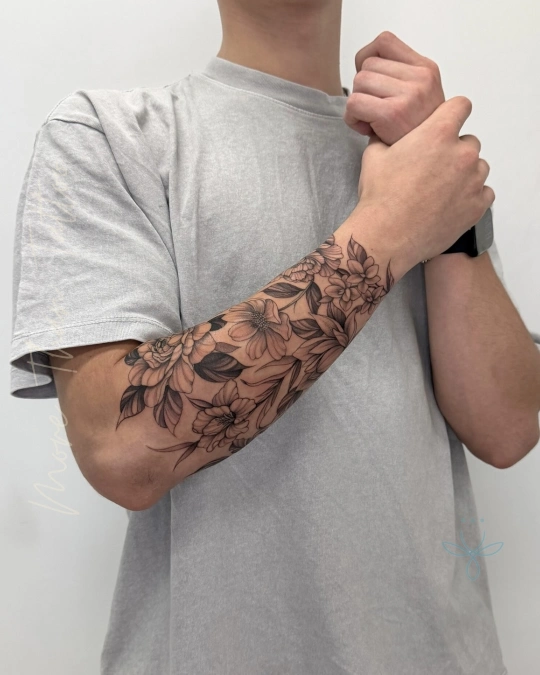
Soft floral blooms wrap entirely around the lower arm. Delicate black linework creates crisp petal edges against the bare skin. Smooth shading builds depth inside the dense leaves. Wandering stems follow the muscle lines with ease.
Treating the forearm like a climbing trellis gives botanical designs a structured yet organic flow.
Heavy shading grounds this delicate subject matter to suit a masculine canvas. Wrapping large-scale flowers around the arm works just like repeating a wallpaper pattern in a narrow room.
Why This Works
Top Anchor: Placing the largest blooms near the elbow joint holds the heaviest visual weight up high.
Airy Gaps: Leaving patches of raw skin between the leaves prevents the dense arrangement from feeling muddy.
Crisp Edges: Mixing sharp outlines with soft grey interior shading builds a highly readable three-dimensional effect.
7. Eclectic Gallery Wall And Fine Line Collection
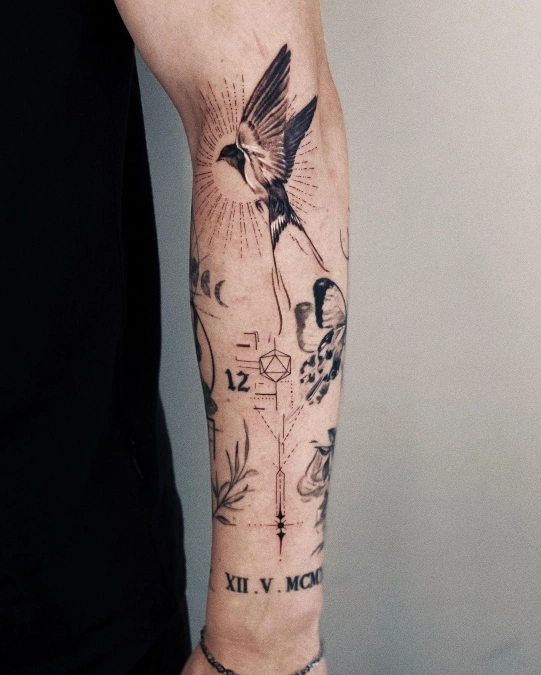
Crisp black ink shapes a soaring swallow surrounded by delicate radiant lines. Thin geometric structures and faded roman numerals float freely over the bare arm. Small organic pieces like leaves and isolated butterfly wings fill out the lower gaps.
Treating raw skin like negative space on a gallery wall lets tiny eclectic pieces breathe
Patchwork layouts work best when you leave plenty of breathing room between individual stamps. Placing the darkest subject near the upper forearm visually anchors the lighter geometric elements below.
8. Fading Geometric Tile Pattern On The Forearm
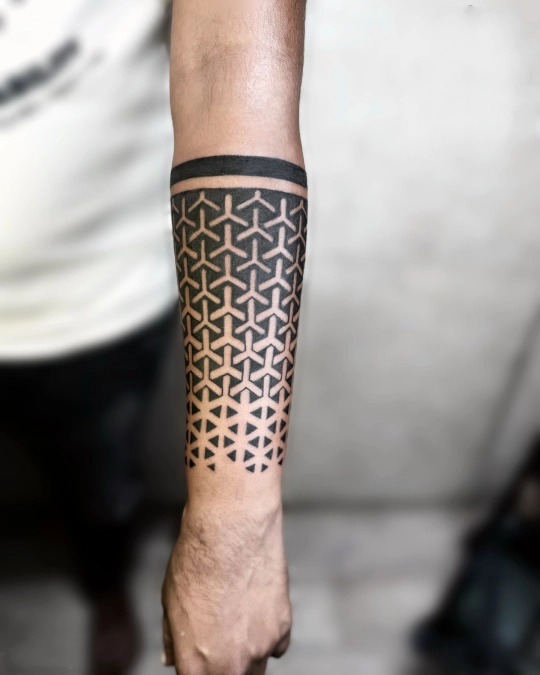
Crisp black geometric shapes lock together in a tight repeating grid below a heavy anchor band. The rigid structure slowly shatters into falling triangle fragments near the bare wrist.
Letting a dense geometric pattern dissolve into negative space keeps the layout from feeling visually heavy.
This structured gradient functions like a modern hexagon tile floor fading into bare hardwood. Guys looking for an architectural sleeve benefit from these dissolving edges since they wrap the limb without a rigid cutoff.
9. High Contrast Color Sweeps And Dark Portraits
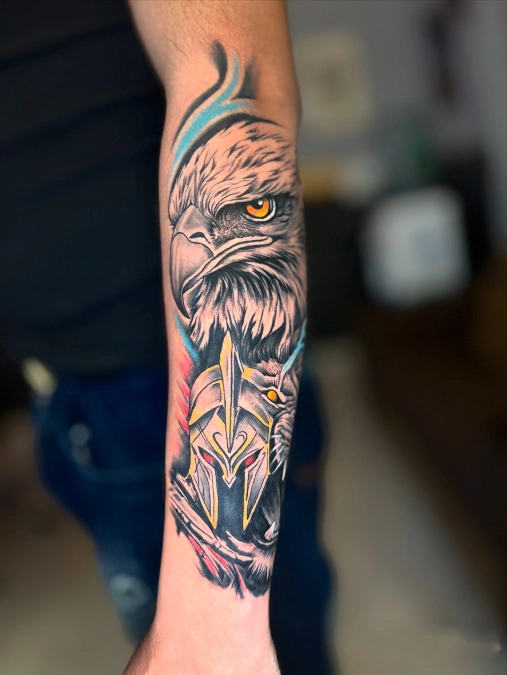
Bright teal and deep red ink slice through heavy black shading like a neon sign in a dark room. A sharp eagle profile crowns the top before shifting into a rigid Spartan helmet. Glowing yellow accents define the helmet edges and the piercing bird eye.
Injecting vibrant color behind heavily shaded realism creates an electric focal point that commands attention.
Framing dark portraits with neon accents works exactly like placing bright abstract art on a charcoal accent wall. This intense layout suits wide forearms where the vivid colors have room to spread out.
Why This Works
Vivid background sweeps pull the eye upward and keep the dark animal portraits from feeling muddy.
Golden yellow highlights inside the eagle eye and helmet visor establish a unified warm tone across multiple subjects.
Stacking three heavy motifs requires a long vertical canvas like the forearm to prevent visual crowding.
10. Central Eye And Symmetrical Mandala Wrap
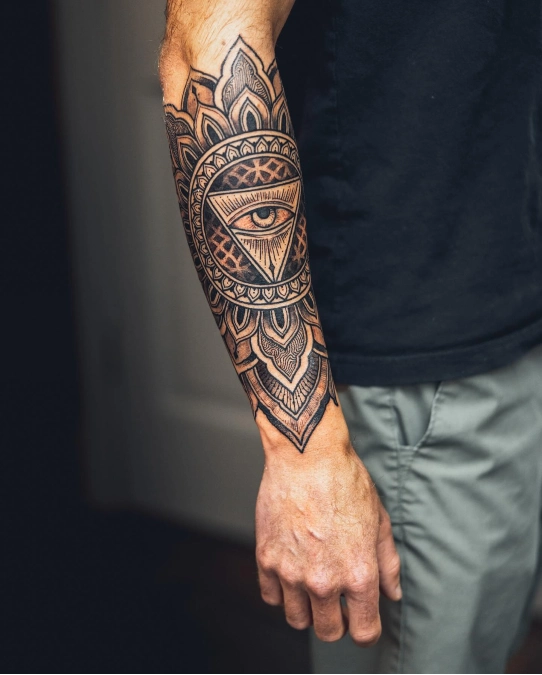
Crisp black lines map out an all-seeing eye inside a rigid triangle. Dense stippling gives the overlapping mandala petals a soft textured finish against the bare skin. Heavy charcoal borders ground the geometric shapes squarely in the center of the forearm.
Centering a massive symmetrical motif on the arm establishes a highly deliberate and grounded visual anchor.
Wrapping tight circular patterns around a cylindrical limb creates a striking illusion of extra width. Men looking for a structured layout get excellent coverage from these radiating designs.
Quick Styling Tips
Budget version Start with the central eye motif and slowly add the expanding geometric petals later on.
Renter tip Keep the darkest shading near the elbow so the lower edges fade softly near the wrist.
Pro move Mix thick heavy outlines with fine dotwork to give the repeating patterns a crisp readable depth.
11. Vertical Sword And Geometric Layout
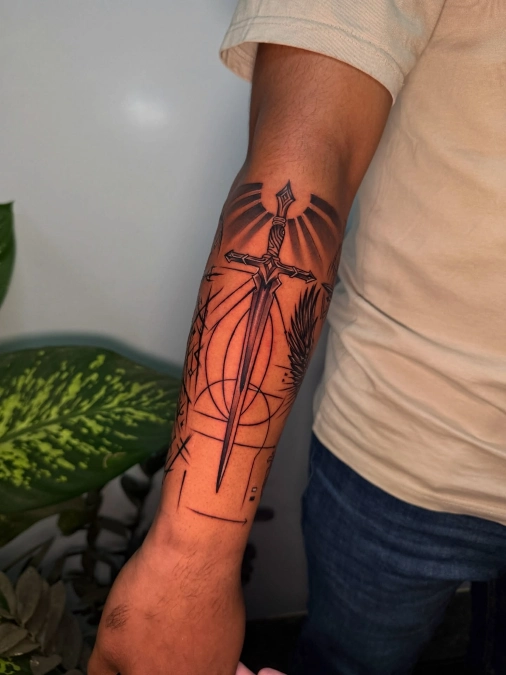
Dark charcoal rays fan out from the top hilt near the elbow crease. Thin overlapping circles slice through the long blade to create a crisp architectural grid.
Placing a long linear object directly down the middle naturally elongates the narrow canvas.
Grounding a tight vertical space requires a strong central axis to anchor the floating details. Adding delicate fine line geometry around the heavy weapon works just like framing a heavy mirror with airy wall sconces.
12. Stacked Casino Motifs And Flowing Smoke
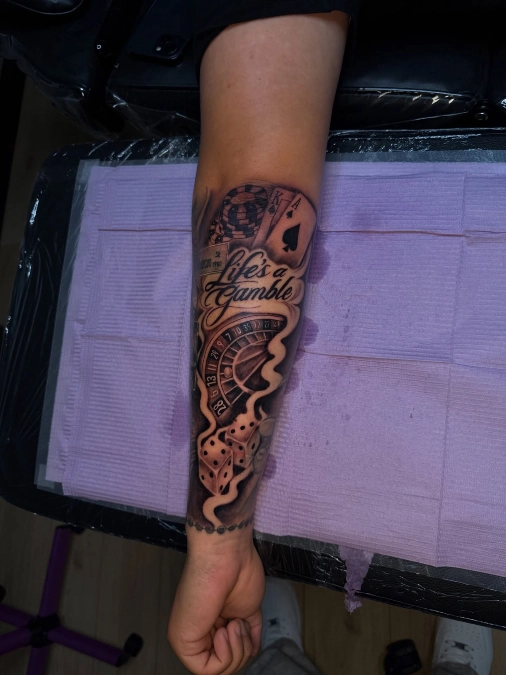
Thick grey shadows billow softly around crisp playing cards and stacked chips. Smooth charcoal ink builds heavy contrast across the detailed roulette wheel. Curling text cuts cleanly through the negative space near the middle.
Wrapping solid game pieces inside airy smoke trails creates natural breaks between dark ink patches.
Layering rigid objects over soft background elements anchors a space much like dropping angular furniture onto a plush rug. Men seeking maximum forearm coverage get excellent value from these fluid transition zones.
13. West Coast Landmarks And Stacked Games
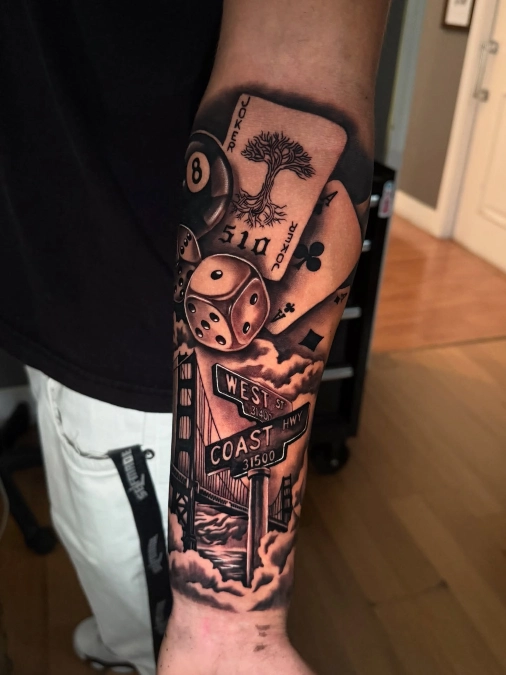
Deep charcoal clouds frame the base of a suspension bridge right at the wrist. Smooth shading adds heavy visual weight to the stacked playing cards and floating dice near the elbow.
Mixing rigid city architecture with floating game pieces builds a structured layout that remains fluid across the skin.
Heavy regional themes need strong anchor points to keep the space from looking chaotic. Dropping the solid bridge at the bottom works exactly like installing dark wainscoting to ground a busy wallpaper pattern.
Why This Works
Floating smoke trails fill the empty gaps between solid objects without adding heavy visual clutter.
Crisp typography on the street signs introduces a sharp industrial texture against the soft paper cards.
Placing the thickest architectural structure near the wrist naturally anchors the lighter floating dice above.
14. Heavy Ornate Filigree And Negative Space Cross
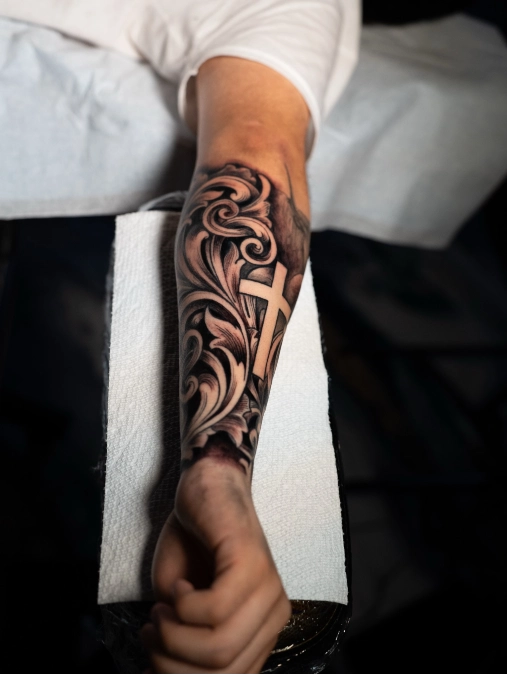
Deep charcoal shading builds thick swirling filigree down the entire forearm. Smooth gradient transitions give the baroque leaves a carved three dimensional texture.
Framing an empty focal point with dense ornamentation makes the blank canvas feel like a deliberate structural element.
High contrast negative space designs need deeply saturated borders to read properly from a distance. Treating the raw skin as your main subject works exactly like letting bright natural light flood into a dark moody room.
15. Script And Compass With Soaring Phoenix
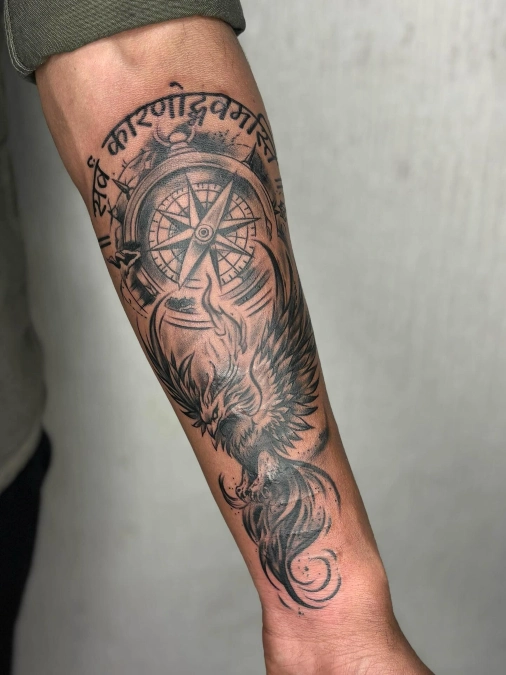
Deep charcoal shading shapes a highly detailed compass right below the elbow. Curved script wraps cleanly around the top edge like an architectural arch. Down near the wrist a soaring phoenix rises with sweeping tail feathers.
Anchoring a flowing organic shape with a rigid geometric topper builds a highly balanced vertical layout.
Mixing sharp typography with soft bird feathers creates excellent textural contrast on a narrow canvas. Guys looking for a heavily layered forearm sleeve get massive mileage from this top down weight distribution.
Why This Typography And Wildlife Combination Works
Top script placement acts as a natural border to cap the upper arm transition cleanly. Heavy geometric shapes anchor the center of the arm to prevent the flowing bird from looking ungrounded.
16. Crown Of Thorns And Armored Knight
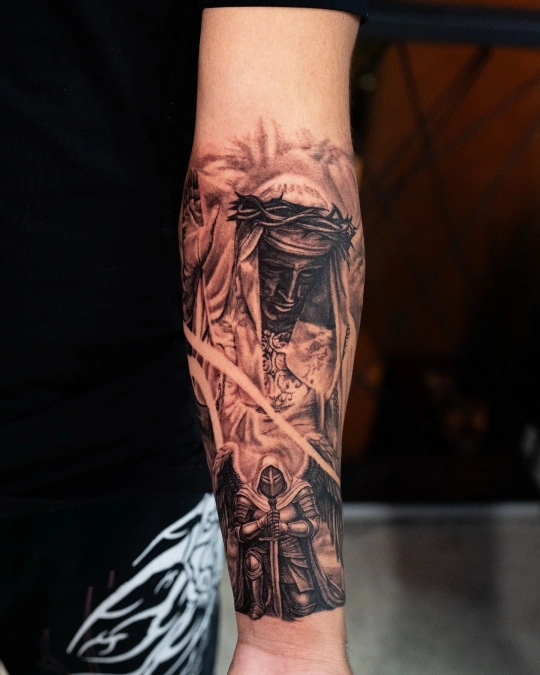
Dense charcoal shading shapes a heavy hooded figure near the elbow. Soft bare skin slices through the dark ink like bright sunlight hitting a moody room. A kneeling metal knight anchors the wrist with crisp metallic textures.
Using raw skin as a glowing light source creates intense readable depth across a dense canvas.
Heavy realism requires a wide surface to keep facial details from warping. Dropping the darkest metal armor near the hand functions exactly like setting heavy oak furniture on a light rug.
17. Traditional Japanese Koi And Cherry Blossoms
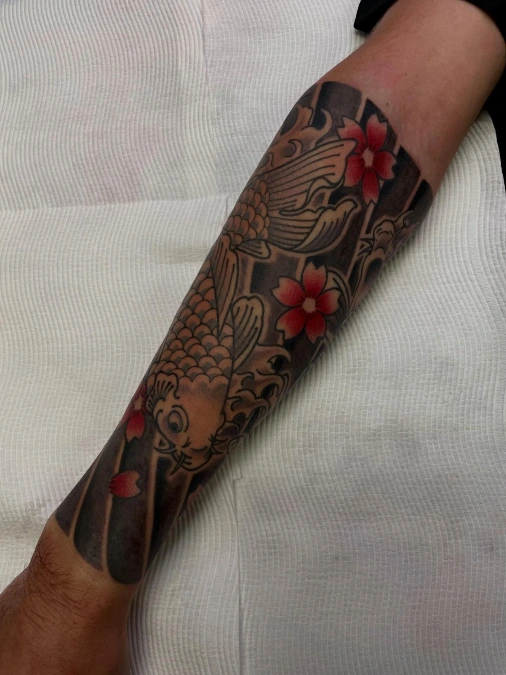
Dense black wind bars ground the entire forearm with heavy visual weight. Bright red cherry blossoms cut cleanly through the dark waves to frame the large central koi fish.
Grounding bright organic colors against deep charcoal shadows creates a striking focal point that demands attention.
High contrast traditional layouts require heavy black backgrounds to make colorful elements pop. Wrapping thick wave patterns around the limb works just like painting a dark accent wall behind vibrant velvet furniture.
Quick Styling Tips
Budget version Ask your artist to start with the central koi fish and fill in the heavy background waves during a later session.
Renter tip Place this dense dark coverage on the lower arm only if you do not need to easily hide it under short sleeves.
Pro move Pack solid white ink into the cherry blossom centers to boost the sharp contrast against the heavy black waves.
18. Dense Tribal Geometry And Heavy Banding
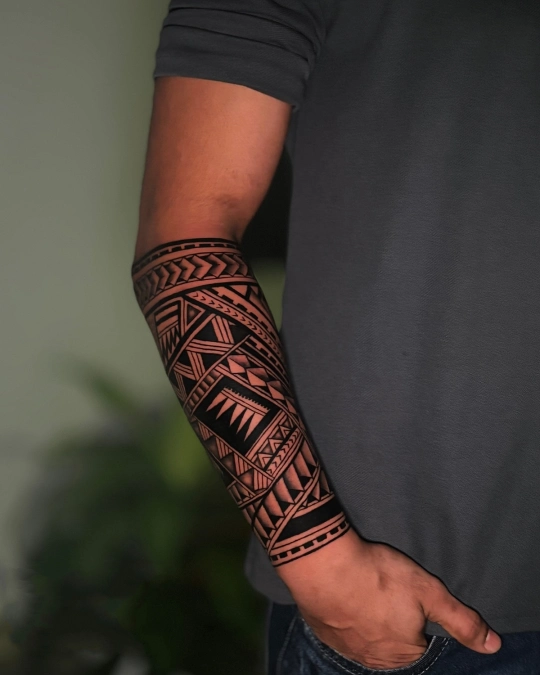
Thick black ink carves rigid geometric pathways down the forearm. Heavy horizontal bands trap complex triangular patterns tightly inside their borders. Sharp chevron lines create a dense woven texture against the bare skin.
Wrapping thick architectural borders around complex internal patterns gives chaotic geometry a clean structural finish.
Dense tribal layouts need strict framing to keep the heavy linework from bleeding together visually. Dropping thick black cuffs at the elbow and wrist functions exactly like adding dark crown molding to a deeply patterned room.
Why This Structured Pattern Works
Solid black boundary lines stop the busy internal triangles from overwhelming the narrow arm canvas. Repeating sharp chevrons naturally point down the limb to create a subtle sense of elongation.
19. Heavy Tribal Sun And Celtic Wrist Knot
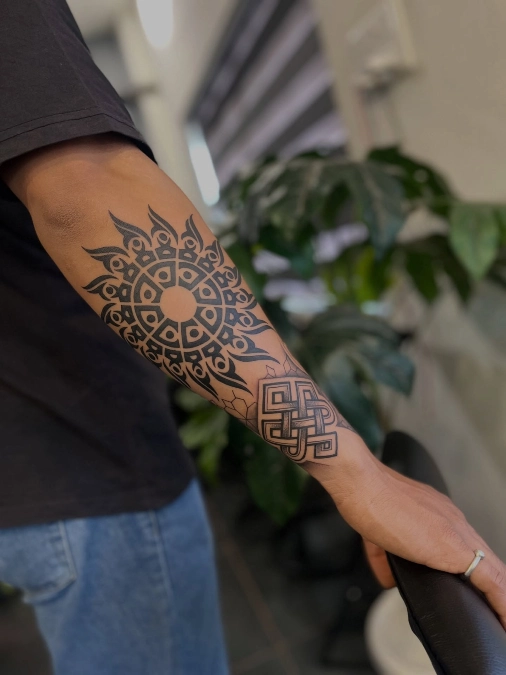
Deep black ink forms a massive radiating sun right across the outer forearm. Thick geometric shapes lock together tightly to build the central circle. A crisp endless knot sits heavily near the hand like a sculpted metal cuff.
Grounding massive tribal shapes with an airy skin-to-ink ratio ensures the heavy design stays incredibly readable.
Leaving negative space inside thick geometric stamps functions exactly like opening a window in a dark room. Men looking for a rugged traditional layout get high impact without the completely blacked-out look.
Quick Styling Tips
Budget version Start with the large central sun and build the lower knot connection later
Renter tip Keep the darkest saturation on the outer arm if you need to maintain a lighter look on the inner bicep
Pro move Ask your artist to drop tiny stippled shading around the edges to soften the harsh black lines
20. Layered Mandala And Geometric Knot
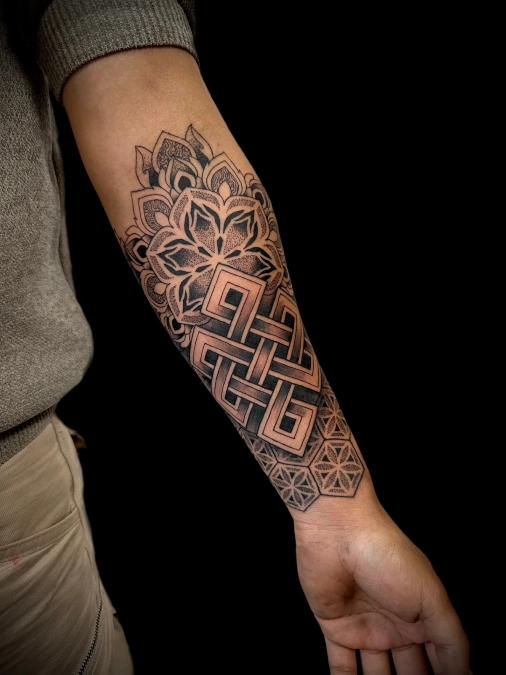
Soft dotwork shapes a delicate floral mandala near the elbow. Crisp grey shading builds a heavy three-dimensional knot across the middle arm. A tight hexagonal grid grounds the lower section right at the wrist.
Centering a rigid architectural knot between soft ornamental patterns provides a strong visual anchor.
Complex layouts require distinct textures to keep heavy ink from blurring together. Treating the middle knot like solid metal gives the lighter stippling room to breathe.
21. Massive Blackout Panels And Sharp Geometric Lines
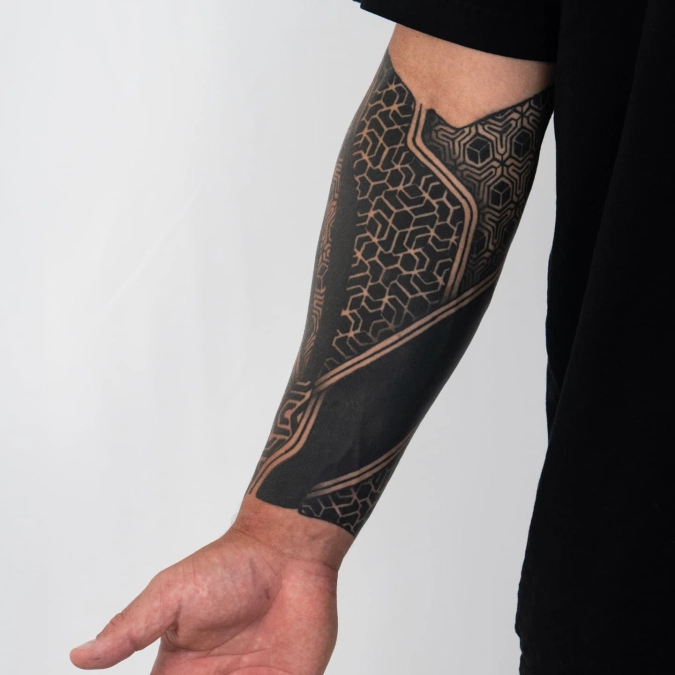
Solid black ink floods the lower arm to build a heavy base. Crisp lines of bare skin slice right through the dark sections. Intricate hexagonal grids fill the upper panels with intense texture.
Placing busy patterns next to solid dark zones creates a highly readable structural layout.
Massive blackout sections work exactly like painting a large accent wall in deep charcoal. Dark areas give your eyes a chance to rest after looking at the busy geometric shapes.