
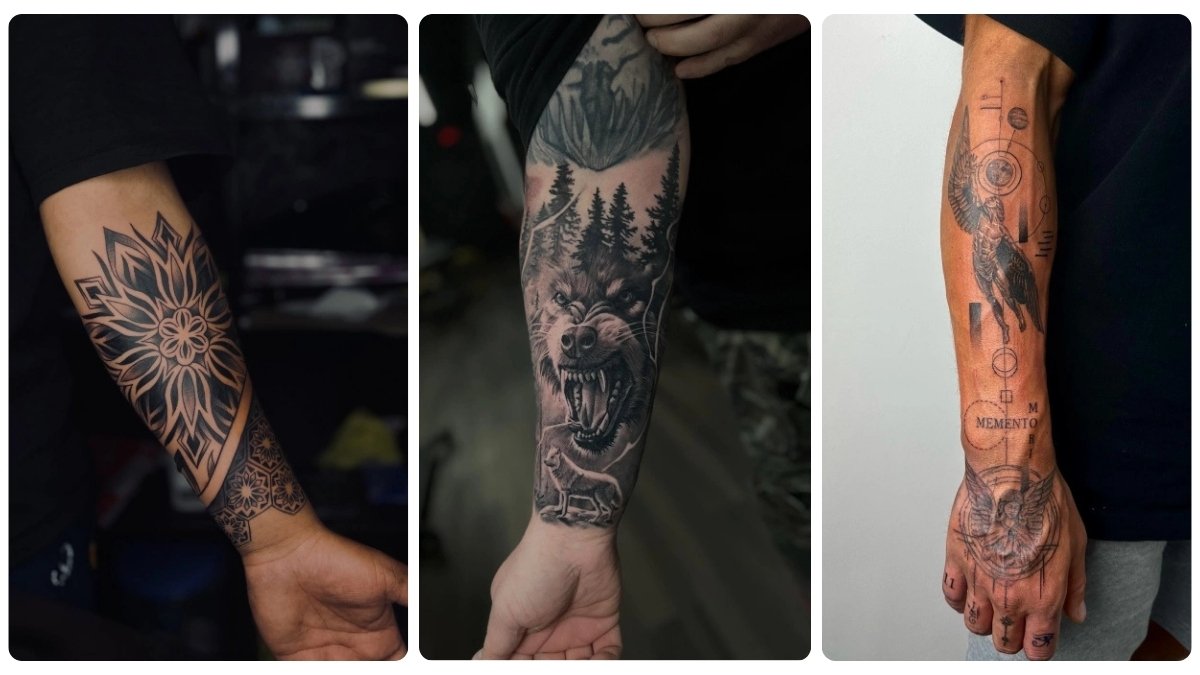
Living with a bold forearm tattoo feels like installing custom millwork in a highly visible entryway. Crisp black lines settle into the skin, offering a permanent texture that catches the light whenever you roll up your sleeves.
This placement works incredibly hard without demanding constant attention. You can showcase the artwork during a casual weekend or hide it under a dress shirt for formal events.
Smart Placement Strong Impact Forearm Layering Tricks
Designing a forearm piece requires the same spatial awareness as arranging a narrow gallery wall. You must respect the natural flow of the muscles to keep the composition from feeling cramped or chaotic.
Heavy traditional pieces anchor the outer arm well, while softer realism thrives on the flat inner panel. Give your main focal point enough negative space to breathe.
INK & TEXTURE
1. Heavy Line Work And Soft Floral Shading
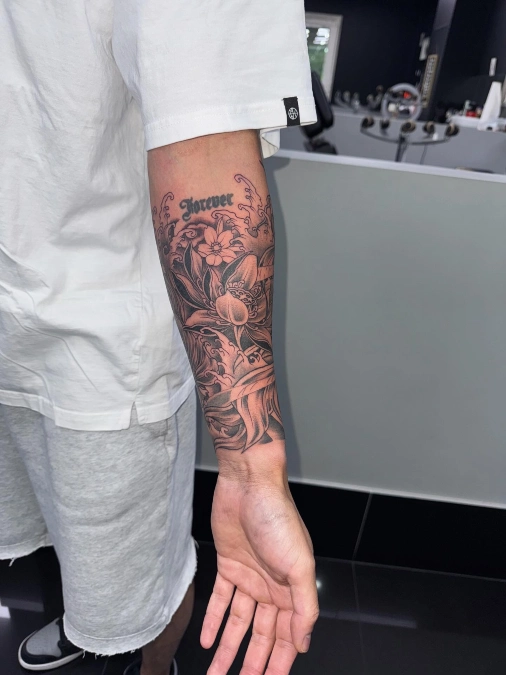
Dense black ink grounds the lower half of this floral composition. Crisp Japanese-style finger waves flow upward, bringing an airy sense of movement to the arm.
Generous negative space acts like a window, letting natural skin breaks illuminate the deep shading contrast.
This layout thrives on the outer forearm because the central flower maps directly onto the long muscle contour. Request solid blacks right next to uninked skin to keep the visual texture sharp over time.
2. Structural Geometric Bands And Tribal Flow
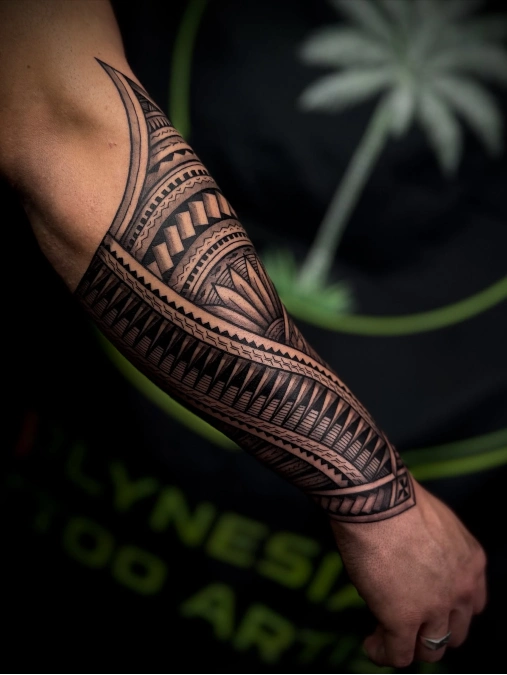
Deep black geometric bands wrap the arm like structural support beams carrying the weight of a heavy ceiling. Crisp triangular motifs layer against soft stippled shading to build serious visual depth across the skin.
Repeating geometric patterns build a solid foundation that feels both powerful and firmly grounded.
Tribal layouts excel on bare arms because the rigid, straight lines contrast sharply against the natural curves of human muscle. Ask your artist to measure the negative skin breaks carefully so the intricate design breathes instead of looking muddy from a distance.
3. High Contrast Realism And Classical Armor
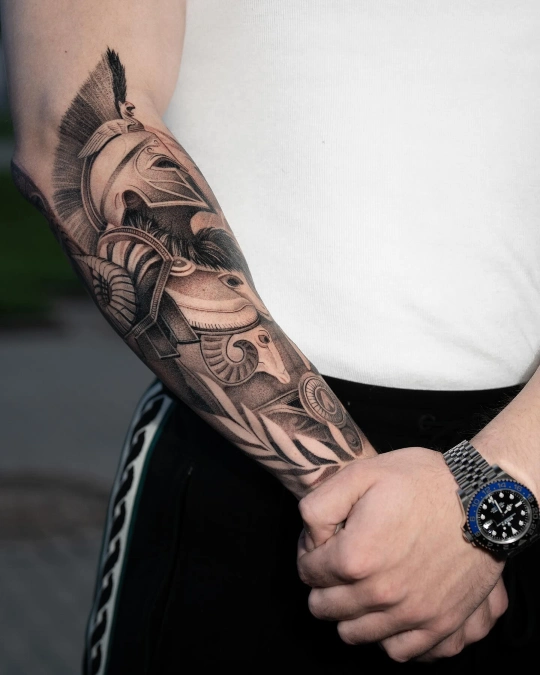
Soft pepper shading builds a matte metallic texture across the heavy Spartan helmet. Crisp white highlights catch the light against the deeply saturated black background.
Dense background shading pushes the lighter central subject forward to build massive visual depth.
Large-scale realism requires broad surface areas to accommodate intricate micro-details. Treat the flat outer panel of the arm like a wide feature wall in an airy living room.
Why This Works
Element 1: Deep black negative space surrounds the main helmet to aggressively boost the overall shading contrast.
Element 2: Smooth gradient transitions create a brushed metal finish that sits flat against the skin.
Element 3: Organic leaf borders wrap the lower arm to soften the heavy architectural lines of the armor.
4. Dark Moody Palettes And Heavy Armor Realism
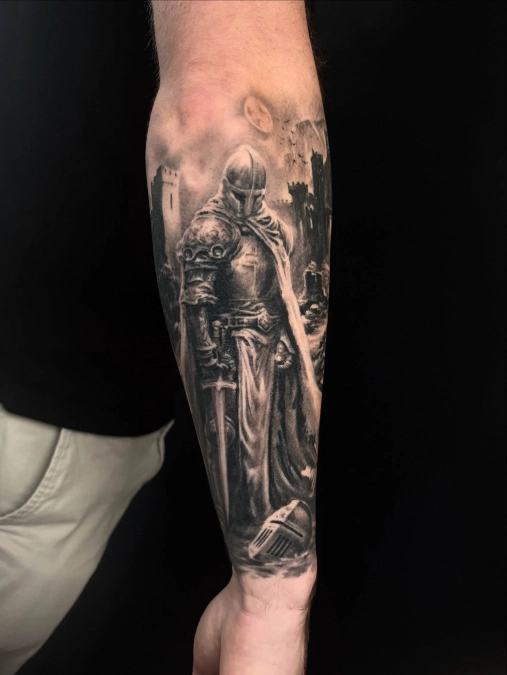
Soft, smoky shading builds a misty castle backdrop that fades cleanly into the upper arm. Deep black tones anchor the heavily armored knight, creating a rugged, forged texture across the metal breastplate.
Strategic negative space cuts through heavy black ink to prevent dense, moody designs from feeling flat.
Full-coverage scenes require careful planning to align heavy focal points with natural muscle contours. Treat this layout like designing a living room with a dark, moody color palette.
Quick Styling Tips
- Budget version: Focus purely on the central knight figure and skip the deep background scenery to cut down on total chair time.
- Renter tip: Test this large-scale placement with a high-quality temporary transfer before committing to the heavy shading of a permanent sleeve.
- Pro move: Ask your artist to punch up the stark white highlights in the cloak to maximize the shading contrast against the dark armor.
5. Symmetrical Mandala And 3D Geometric Cuffs
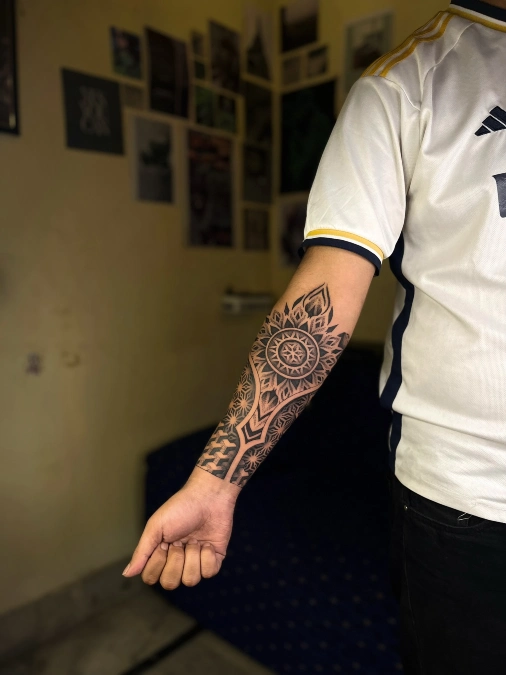
Crisp stippling builds an airy, layered mandala directly across the inner forearm. Sharp cubic patterns ground the design near the wrist, adding a chunky visual anchor to the arm.
Wide uninked borders act like open hallways, guiding the eye smoothly through heavily textured spaces.
Symmetry performs best on the flat panel of the inner arm where the skin rarely twists or distorts. Treat this structural layout exactly like centering a large patterned rug in an open living room.
6. Heavy Woodland Realism And Lightning Accents
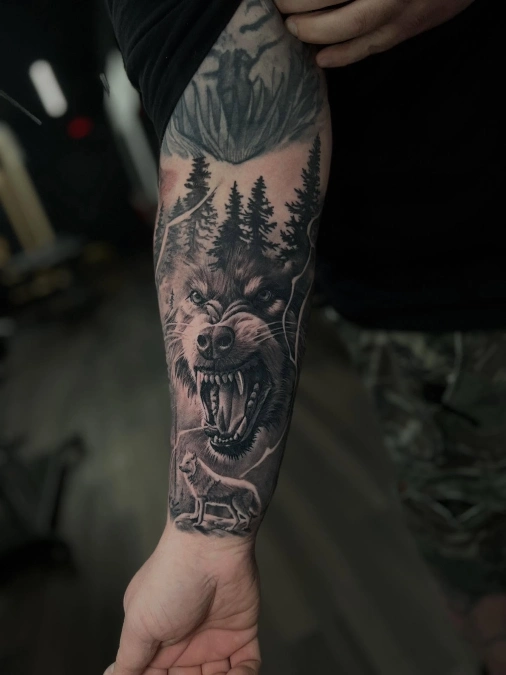
Charcoal shading sculpts a highly textured wolf portrait right across the center forearm. Jagged negative space cuts through the dark fur to mimic cracking lightning strikes.
Sharp white highlights slice through heavy black ink to keep aggressive focal points from reading as flat.
Rich, nature-inspired realism demands high contrast to stay legible over the years. Treat this layered composition like styling a rustic cabin living room with massive mahogany furniture.
Why This Works
Element 1: A small wolf figure at the base establishes scale and pushes the main portrait deeper into the background.
Element 2: Crisp skin breaks provide necessary visual relief amidst the heavily saturated charcoal fur.
Element 3: Faded tree lines act like a soft wallpaper border, blurring the harsh edges of the design into the bare arm.
7. Large Scale Mandala And Diagonal Spacing
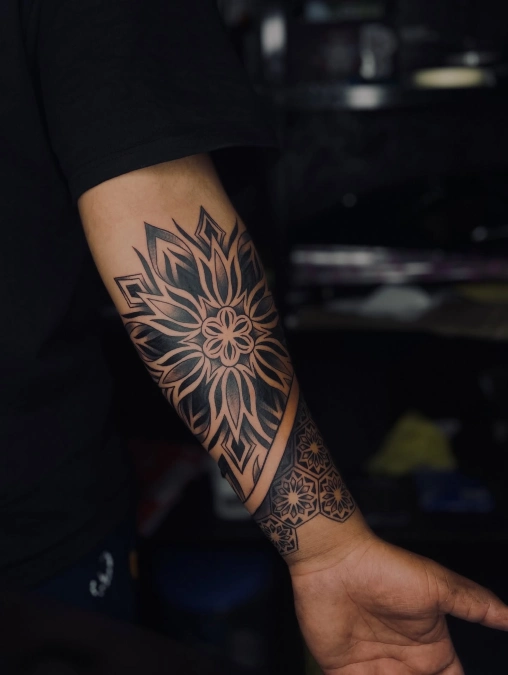
Soft grey shading fills the wide petals of this massive central mandala. A sharp diagonal band of bare skin cuts right across the lower arm. Below this stark dividing line, tightly packed geometric hexagons create a dense, weighty cuff at the wrist.
A thick diagonal break acts like a clear hallway, cleanly separating two heavy patterns without causing visual clutter.
Mixing two distinct layouts right next to each other requires a strong physical boundary. Treat this composition like zoning an open-concept loft with strategically placed furniture.
8. Heavy Blackwork Eye And Layered Honeycomb Geometry
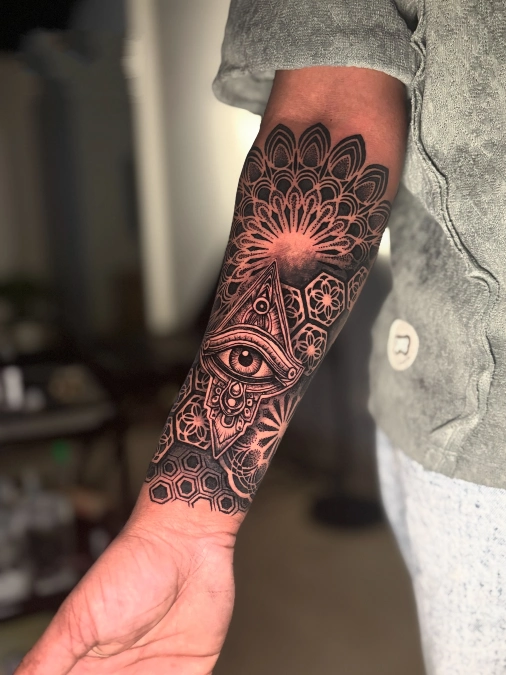
Deep black ink saturates the heavy half-mandala near the elbow. Crisp honeycomb grids frame the central eye, creating a plush, high-contrast texture against the bare skin.
Heavy geometric frames act like solid window casings to highlight a highly detailed central focal point.
This structured layout excels on the inner arm because the flat surface prevents precise circles from warping. Treat this dense design like anchoring an eclectic living room with a heavy, carved wooden coffee table.
Quick Styling Tips
- Budget version: Outline the central triangle and eye during your first appointment, saving the dense honeycomb background for a later session.
- Renter tip: Test the exact placement using a transfer paper stencil to guarantee the focal point sits squarely when your arm hangs naturally.
- Pro move: Ask your artist to pack heavy black pigment into the mandala edges to push the lighter interior dotwork visually forward.
9. Fine Line Realism And Airy Celestial Geometry
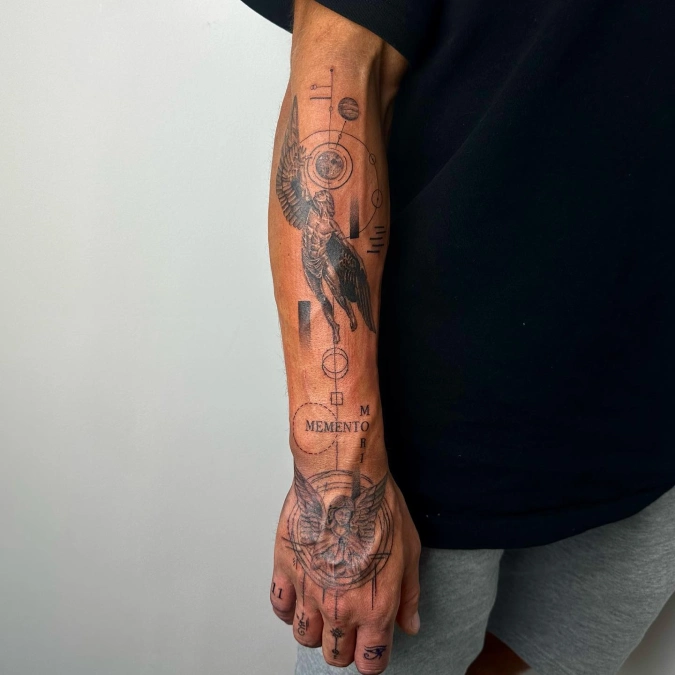
Crisp geometric lines map out a celestial chart right across the bare inner forearm. Soft grey shading builds a highly detailed winged figure falling through wide stretches of airy negative space.
Delicate linework acts exactly like wireframe furniture, providing clear structure without adding heavy visual weight to the skin.
Fine needle layouts thrive on the flat planes of the arm where the canvas stays relatively smooth. Treat this minimalist approach like styling a bright, sunlit reading nook.
Why This Airy Layout Works
Element 1: Sharp architectural mapping provides rigid framing for the soft, organic shading of the central figure.
Element 2: Generous uninked gaps function like blank gallery walls, highlighting the tiny planetary micro-details.
Element 3: Sturdy typography near the wrist joint grounds the entire composition so the upper graphics can visually float.
10. Dark Surrealistic Octopus And Winding Tentacle Wraps
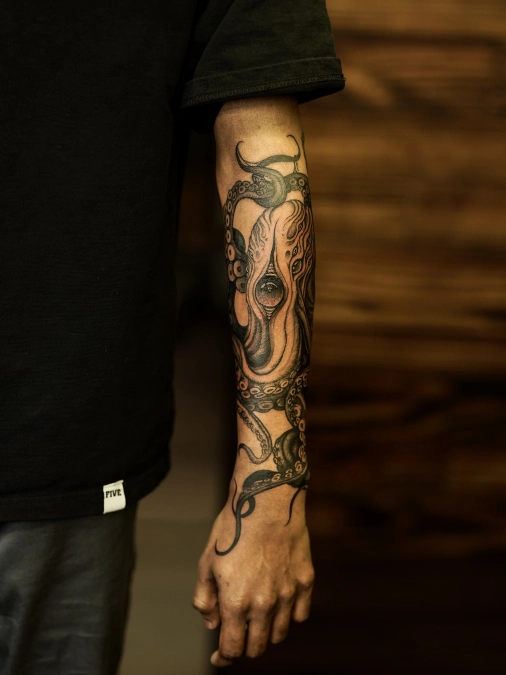
Heavy black shading gives this central octopus figure a dense, sculptural weight right on the middle forearm. Winding tentacles creep down toward the wrist and spiral up near the elbow crease.
Fluid, organic shapes wrap the arm naturally exactly like a curved staircase anchors an open floor plan.
Serpentine designs excel on the forearm because they utilize the full cylindrical canvas without breaking the visual flow. Treat this wrapping layout like draping a heavy velvet runner across a long dining table.
11. Vertical Typography And Schematic Bird Portraits
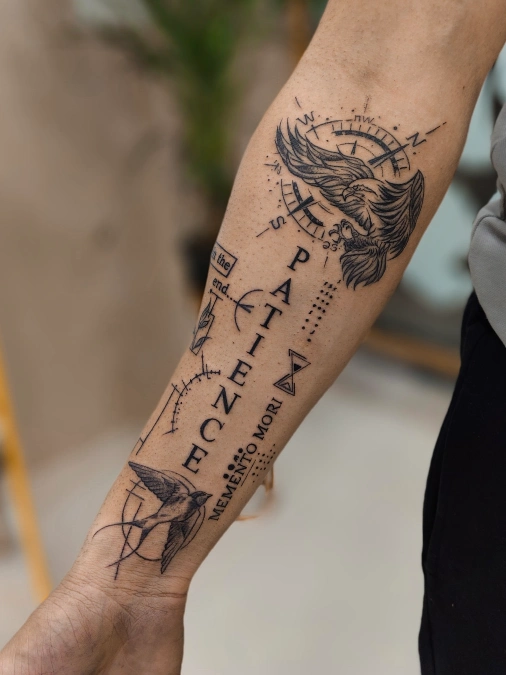
Crisp serif lettering drops straight down the center forearm like a load-bearing column. Floating geometric crosshairs and dotted lines provide a lightweight framework around the bold text.
Vertical text layouts act like strong architectural pillars to anchor floating disconnected graphics.
Patchwork designs rely heavily on negative space to keep individual pieces from looking cluttered. Treat this minimalist approach like hanging a sparse gallery wall in an airy home office.
Quick Styling Tips
- Budget version: Focus on the central typography first and add the smaller compass or bird sketches during later sessions.
- Renter tip: Map out the lettering with a stencil while standing relaxed to ensure the word drops straight down the natural line of the muscle.
- Pro move: Request slightly thicker line weights on the outer geometric borders to visually match the heavy saturation of the main font.
12. Horizontal Animal Realism And Bright Color Pops
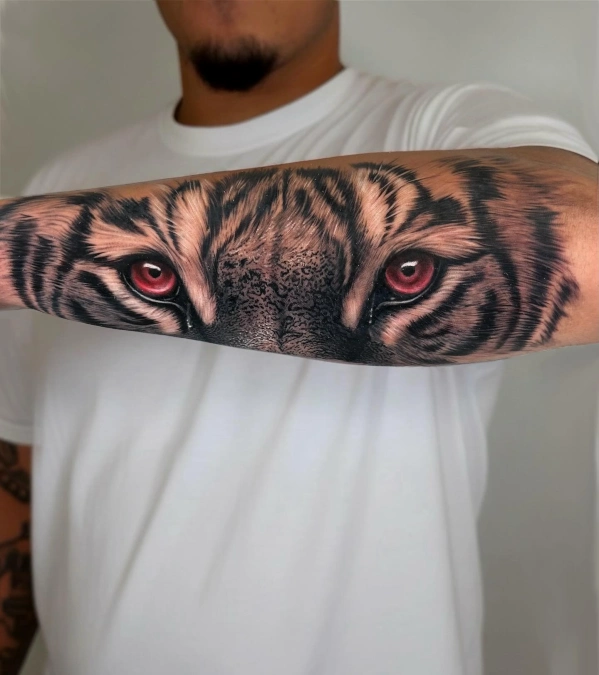
Deep black stripes frame a hyper-realistic tiger portrait stretching straight across the inner forearm. Plush grey shading builds a highly textured coat that feels thick and tactile right on the skin.
A solitary splash of heavy color behaves exactly like a bright statement chair, instantly waking up a dark, monochromatic room.
Wide horizontal subjects demand a completely flat surface so the strict proportions do not distort when your arm twists. Treat this precise placement just like centering an oversized landscape canvas above a long credenza.
Why This Works
Element 1: Heavy black shadows along the outer edges push the lighter center bridge of the nose forward to establish massive visual depth.
Element 2: Stark red ink delivers a crucial, high-contrast focal point that keeps the dense grey fur from looking washed out over time.
Element 3: The tight horizontal crop eliminates distracting background scenery to keep the aggressive gaze commanding total attention.
13. Heavy Blackwork Tiger And Atmospheric Scenery
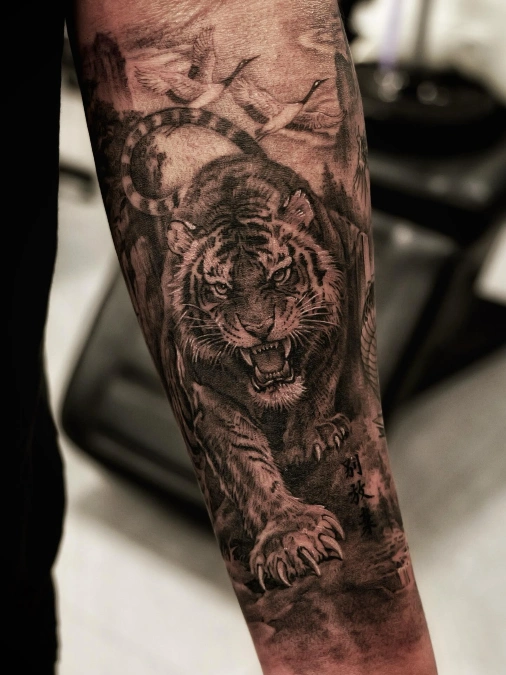
Soft grey shading builds a dense mountain scene across the upper forearm. Deep black pigment anchors the prowling tiger, giving the heavy fur a plush, tactile finish. Delicate cranes fly through lighter negative space near the elbow to break up the dark backdrop.
Dense background shading functions exactly like moody wallpaper, pushing the lighter central figure sharply into focus.
Large realism pieces require precise placement so the main focal point maps cleanly over the flat muscle contour. Treat this heavy composition like styling a dark, maximalist library around a huge leather armchair.
14. Heavy Botanical Vines And Dark Organic Shading
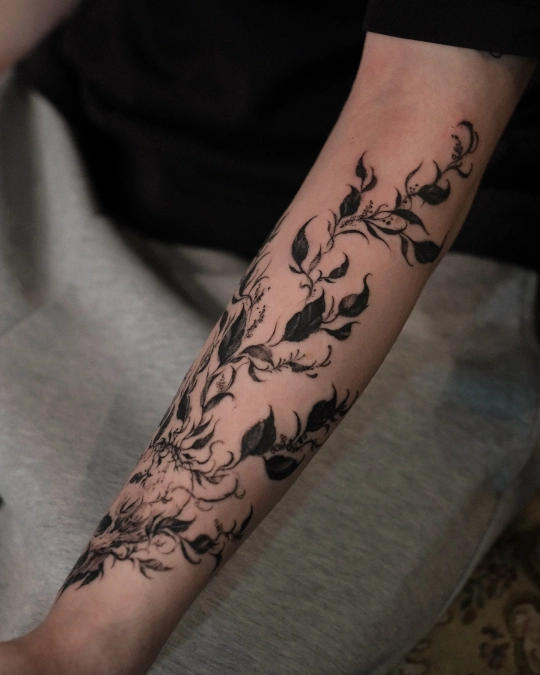
Deep black pigment saturates the loose, winding leaves right across the inner arm. Generous negative space cuts through the dark botanical clusters to give the climbing vines a crisp, airy texture.
Strong shading contrast relies on wide uninked gaps to keep organic patterns feeling wild and unrestrained.
Trailing layouts perform exceptionally well here because they naturally track the long muscle contour. Treat this loose composition like draping an overgrown pothos plant across a stark white bookshelf.
Quick Styling Tips
- Budget version: Focus on the primary winding stem first and add the thick black leaves during a later appointment.
- Renter tip: Map out the placement with a marker to check how the pattern twists when you naturally rotate your wrist.
- Pro move: Request tiny stippled dots around the main clusters to soften the harsh black edges against your bare arm.
15. Fine Line Geometry And Samurai Silhouette
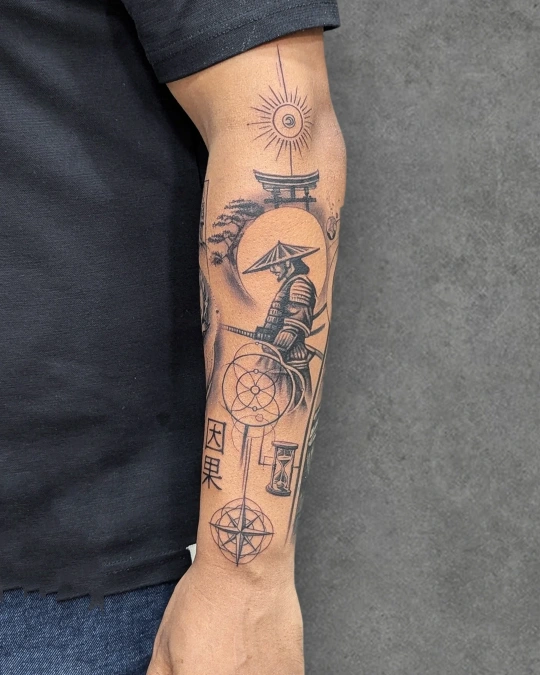
Crisp fine lines build a geometric sun directly over a heavily shaded samurai figure. Soft pepper shading frames the central warrior, creating a misty backdrop that feels incredibly airy against the bare skin.
Mixing rigid geometric frames with soft portrait shading acts exactly like hanging a sharp metal mirror above a plush velvet sofa.
Patchwork compositions excel on the outer forearm because you can stack distinct elements vertically along the natural bone structure. Treat this layered layout like designing an eclectic gallery wall in a narrow hallway.
Why This Works
Element 1: A stark uninked circle highlights the central samurai to aggressively push the dark armor visually forward.
Element 2: Thin vertical line weights connect floating compass points to solidly ground the disconnected lower graphics.
Element 3: Faded background pine trees introduce a soft organic texture to effectively contrast the rigid geometric foreground.
16. Heavy Blackwork Sombrero And Skeletal Realism
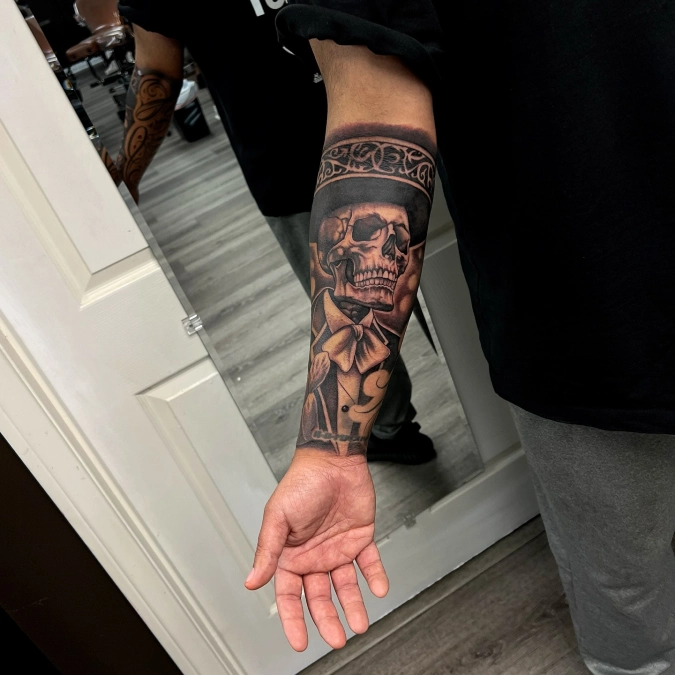
Deep charcoal shading anchors the wide sombrero right near the elbow crease. Intricate ornamental filigree bands across the heavy black brim, framing the skeletal face like a structured headboard.
Solid dark borders function exactly like thick picture frames, containing intricate central subjects to prevent them from bleeding into bare skin.
Tall vertical portraits require the longest, flattest portion of the inner arm to maintain their rigid proportions when the muscle twists. Treat this high-contrast layout like anchoring a bright, sunlit hallway with a massive dark accent wall
17. Heavy Tiger Realism And Soft Stippled Clouds
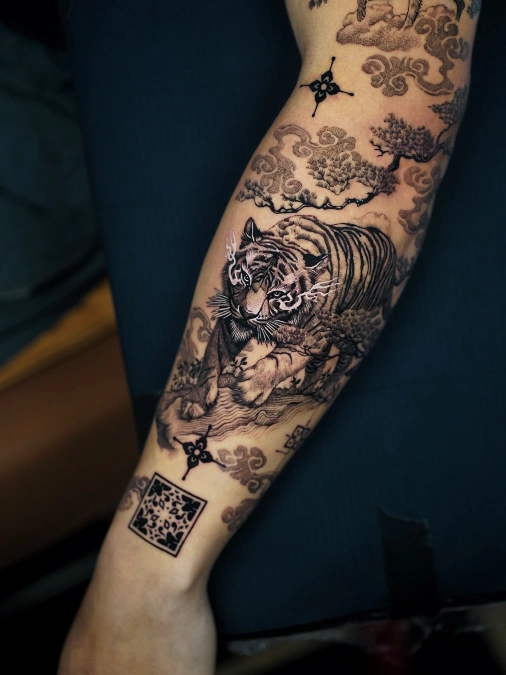
Soft stippled clouds drift across the upper forearm, introducing an airy texture to the traditional pine silhouettes. Heavy charcoal shading builds a dark, moody palette across the prowling tiger right in the center of the arm.
Sharp geometric stamps act exactly like modern metal hardware, giving classic organic motifs a crisp, structured edge.
Layering deep ink requires you to align the primary focal point precisely with the natural muscle contour. Treat this transitional layout like hanging a heavy, ornate mirror in a bright minimalist hallway.
18. Dark Moody Realism And Hooded Skull Composition
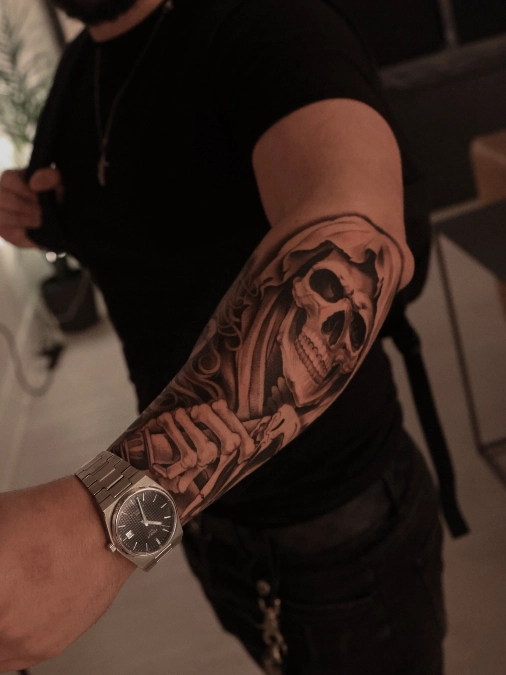
Deep charcoal shading drapes a heavy hood directly around the central skull on the outer forearm. Soft, plush gradients sink into the hollow eye sockets to build immense depth against the bare arm.
Dense black shadows act like a thick velvet curtain, pushing lighter focal points sharply into the foreground.
Large realism pieces require the widest, flattest portion of the muscle to prevent structural warping when your arm moves. Treat this moody layout exactly like anchoring a grounded bedroom with dark, matte painted walls.
Why This Works
Element 1: Heavy black pigment packs into the hood folds to guarantee maximum shading contrast against the exposed skull.
Element 2: Generous negative space along the skeletal jawline provides crucial visual relief within an incredibly dense design.
Element 3: The slanted lower handle firmly grounds the bottom of the piece, naturally tapering the heavy artwork toward the wrist joint.
19. Heavy Chicano Script And Folded Currency Realism
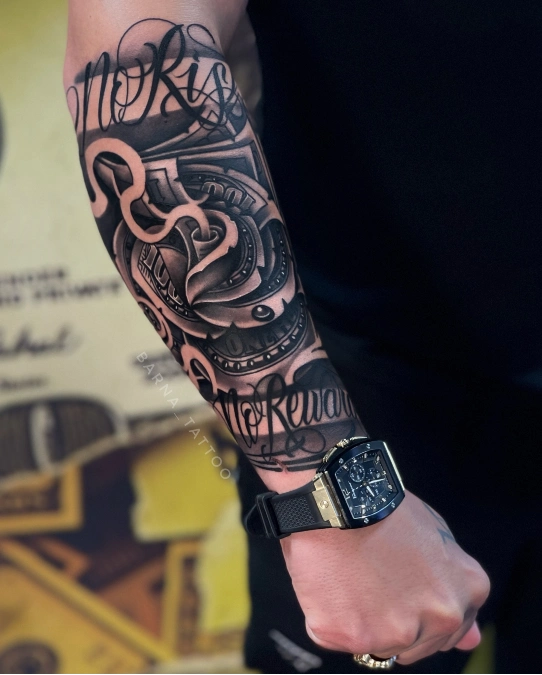
Deep charcoal gradients build a tightly folded money rose right across the central forearm. Crisp negative space creates thick ribbons of smoke that weave naturally through the heavy black petals.
Thick ribbons of uninked skin act exactly like bright hallway lighting, guiding the eye smoothly through a heavily saturated space.
Dense realism designs require strict muscle contour alignment so the rounded petals do not warp when your arm twists. Treat this structured layout like centering a plush leather sofa between two dark bookcases.
Quick Styling Tips
- Budget version: Outline the central money rose first and save the heavy top and bottom typography for a follow-up session.
- Renter tip: Map the large lettering with a stencil while your arm hangs naturally at your side to guarantee the wording stays completely legible.
- Pro move: Ask your artist to punch bright white highlights into the smoke trails to aggressively boost the overall shading contrast against the dark background.
20. Minimalist Bird Silhouette And Golden Eye Accents
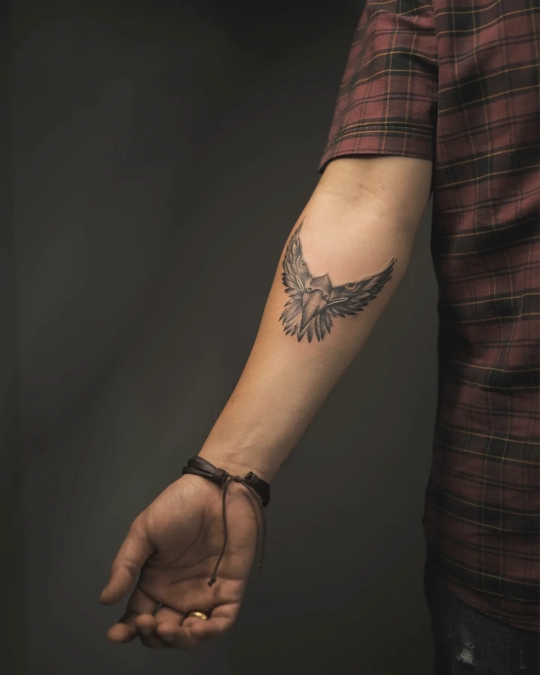
Soft grey shading builds a compact, plunging bird right below the inner elbow crease. Crisp black feathers taper cleanly into the bare forearm to create a tight, structured shape.
A solitary, high-contrast focal point functions exactly like a dramatic pendant light dropping into a stark, empty entryway.
Floating minimalist designs demand a massive amount of uninked skin to look intentional rather than unfinished. Treat this compact placement like centering a small, intense painting on a wide blank wall.
21. Sharp Geometric Band And Mountain Silhouette
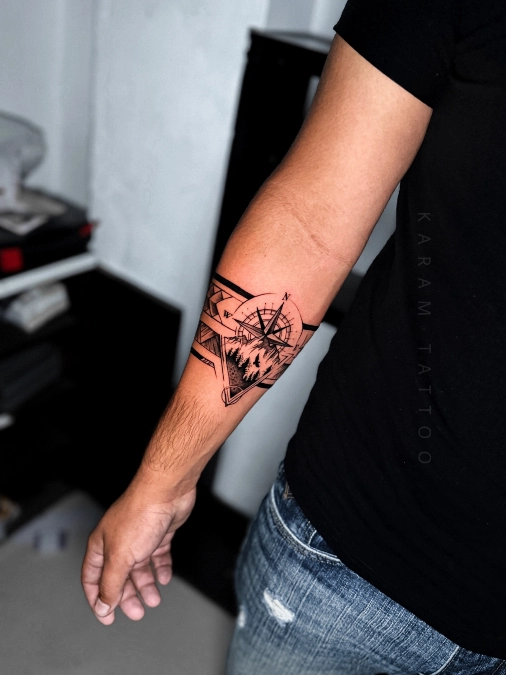
Crisp black lines wrap the upper forearm to create a structured cuff. A precise compass star anchors the piece right in the center. Dense pine trees and jagged peaks drop into the lower triangle.
Heavy horizontal borders function exactly like dark crown molding, giving sprawling organic shapes a rigid, contained structure.
Wrapping layouts excel at breaking up a long, bare arm. Treat this optimized design like zoning a minimalist living room with a solid rug. You must lock the heaviest ink near the middle.
Why This Works
Element 1: Thick parallel lines establish a firm architectural boundary that prevents the inner wilderness scene from floating aimlessly.
Element 2: Deep black pigment inside the lower triangle pushes the lighter mountain ridges sharply into the foreground.
Element 3: The extended compass needle smoothly guides the eye downward without cluttering the highly contained layout.
22. Heavy Geometric Borders And Structured Mandala Cuffs
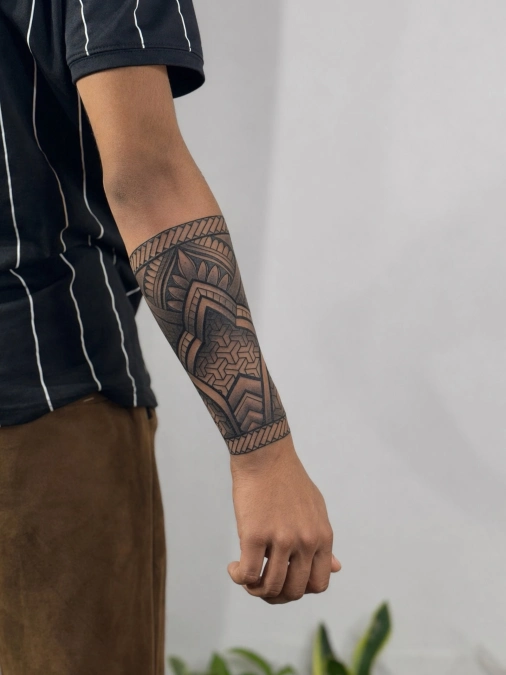
Dense black ink weaves a tight cubic pattern right down the center of the outer arm. Thick braided bands wrap the wrist and elbow to create a massive, structured cuff.
Thick horizontal borders function exactly like dark baseboards, grounding busy interior patterns so they feel deliberate rather than chaotic.
Wrapping layouts demand strict proportion control to keep rigid lines aligned with your natural muscle contour. Treat this dense composition like laying a heavy patterned rug in a narrow hallway.
Quick Styling Tips
Pro move: Request deep charcoal saturation inside the pointed arches to visually push the lighter 3D cubes firmly into the foreground.
Budget version: Focus purely on the inner cubic geometry first and save the heavy woven borders for a second session.
Renter tip: Test the scale with a paper stencil to guarantee the thick top band sits comfortably below your elbow crease.
23. High Contrast Black And Grey Roses
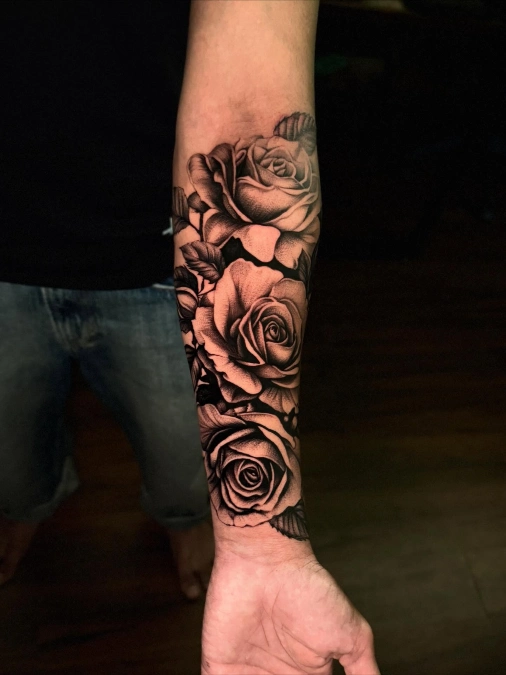
Deep charcoal shadows sink into the core of these three massive blooming roses right along the inner arm. Soft, powdery gradients build plush, velvety petals that catch the ambient light against the stark black leaves.
Heavy black shading drops the surrounding foliage into deep shadow, forcing the lighter floral centers to burst visually forward.
Stacking three identical elements builds a powerful sense of rhythm down the natural muscle contour of the forearm. Treat this cascading layout exactly like arranging a trio of matching pendant lights over a long, dark kitchen island.
Why This Works
Element 1: Crisp uninked skin breaks along the outer petal edges provide crucial visual relief against the heavily saturated background.
Element 2: The strict vertical alignment maps flawlessly onto the flat inner arm so the large circular blooms do not warp when you twist your wrist.
Element 3: Deep black pigment packed into the leaves acts like dark wainscoting, firmly grounding the softer, delicate textures of the roses.
24. Dense Blackwork Peony And Hidden Skull Profile
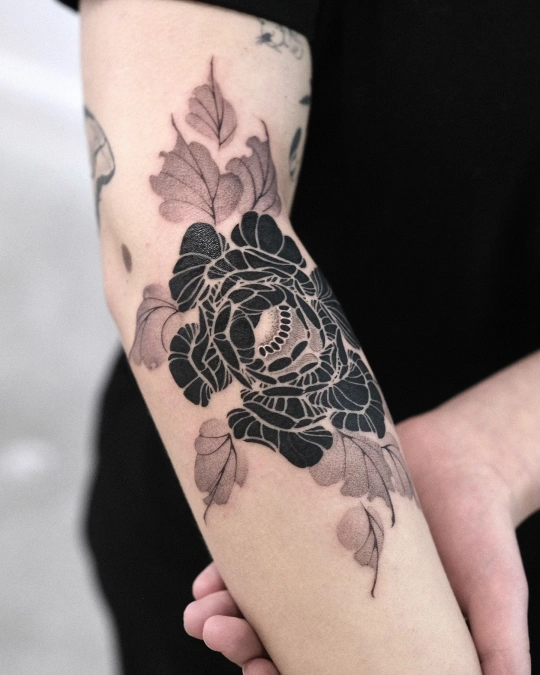
Solid black ink floods the broad petals of this central peony to create a massive, weighty focal point right near the elbow. Crisp uninked lines map out a hidden skull profile tucked deeply into the floral core.
Heavy focal points require soft surrounding textures exactly like a stark modern coffee table needs a plush wool rug.
High-contrast blackwork excels on the wide outer forearm because the bold shapes stay legible from across the room. Treat this dense layout like designing a moody, dark-painted bedroom.
Quick Styling Tips
- Budget version: Pack solid black into the main floral silhouette first and save the dusty background foliage for a future session.
- Renter tip: Test the placement with a temporary stencil while bending your elbow to ensure the hidden skull does not warp during daily movement.
- Pro move: Ask your artist to drop the shading opacity on the outer leaves to aggressively maximize the visual contrast of the solid black center.
25. Layered Cloud Realism And Dramatic Light Rays
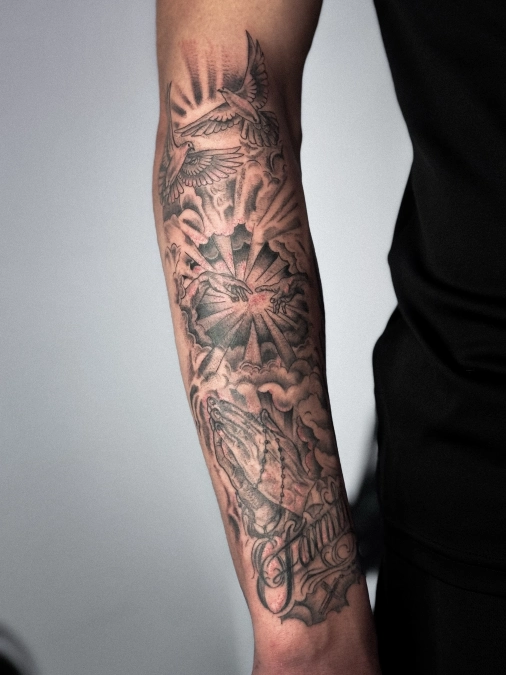
Soft grey shading builds a plush, heavily textured backdrop from the inner elbow straight down to the wrist. Crisp geometric sun rays cut sharply between the central hands, adding brilliant contrast against the dark background.
Sharp directional lines act like bright architectural spotlights, slicing through dense shadows to highlight your most important focal points.
Full-coverage sleeves require careful sectioning to keep individual elements from bleeding into a messy block of ink. Treat this stacked layout like designing an open-plan living room with very distinct functional zones.