
Treating skin like a blank wall changes how you view body art. Crisp black ink anchors the inner arm much like a dark fixture grounds a bright hallway. Soft shading adds plush texture to an area usually hidden away.
Choosing this spot makes serious practical sense. Fresh pieces stay sharp longer here because they dodge daily sun damage. Professionals appreciate this location since long sleeves hide the design during work.
Frame Your Canvas How to Style the Inner Bicep
Working with the natural curve of your arm requires the same planning as fitting furniture into an alcove. Designs need room to breathe so they do not warp when your muscle flexes.
Bold styles hold up best in this high-friction zone. Delicate fine-line pieces act like fragile silk pillows, requiring careful upkeep because the arm rubs constantly against your ribs.
Ink Application
Classic Flash Design
High-Contrast Lighting
Use heavy negative space to create intense artificial light and depth within the design itself.
Gritty Texture
Whip shading mimics the feel of rough canvas, adding serious visual weight to the skin.
Focal Point Strategy
Center the heaviest part of the art directly on the widest section of the bicep.
Budget Optimization
Classic flash pieces often cost less than custom sleeves while guaranteeing strong, lasting results.
1. Bold Guardian Bicep Armor
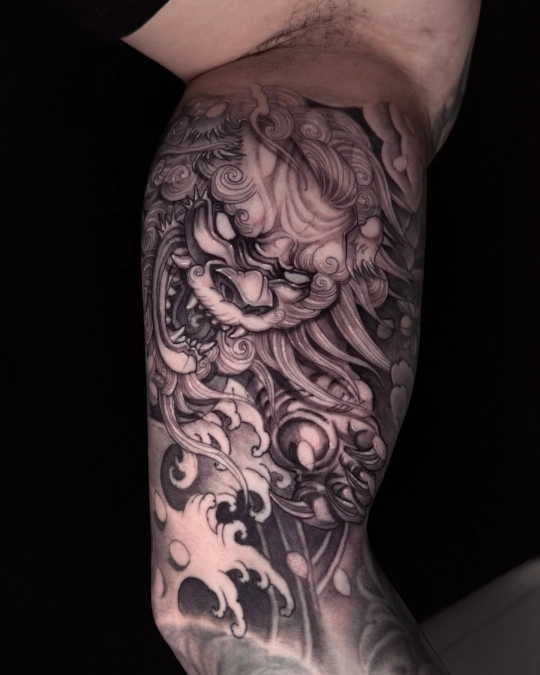
Crisp black ink sculpts the ferocious expression of this Japanese guardian lion directly onto the pale skin of the inner bicep. The design feels grounded and powerful, anchoring the arm with immediate visual weight and intricate texture.
High-contrast grayscale ensures this protective symbol remains clearly defined for decades.
This placement protects the detailed grey wash shading from daily sun exposure, keeping the pigment looking fresh and sharp. The structure relies on massive shapes the blocky snout and broad forehead which hold up better over time than delicate patterns.
2. Geometric Blueprint Gallery Wall
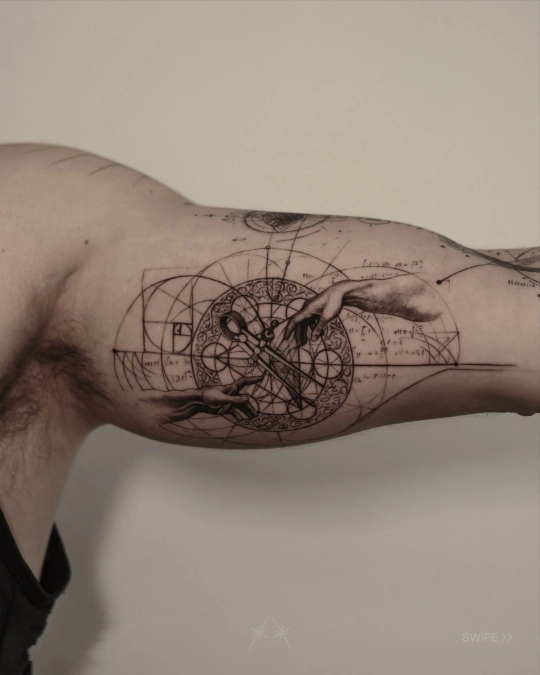
Crisp, hair-thin lines map out complex math and geometry across the pale skin like architectural plans on a drafting table. Two shaded, sculptural hands reach toward a central compass within a textured circular focal point.
Negative space acts as the primary background color to keep fine-line details from looking cluttered.
Highly technical fine-line work needs a flat, stable foundation to prevent straight lines from warping over time. The inner bicep acts as a reliably smooth gallery wall, keeping delicate linework safe from heavy sun fading.
3. Dramatic Light Ray Focal Point
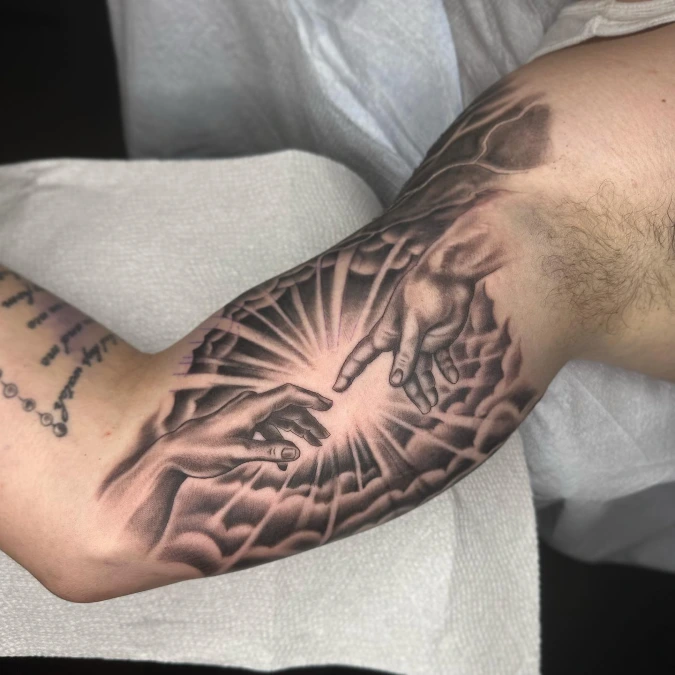
Deep charcoal clouds frame the reaching hands, building a moody border across the soft inner bicep. Radiant beams of untouched skin pierce the heavy shading to mimic natural sunlight flooding a dark room.
Using pure skin as your brightest light source builds an undeniable central focal point.
This high-drama layout works brilliantly on wider arms because the sprawling sunbeams align cleanly with natural muscle contours. Treat heavy background shading like painting a ceiling dark; you need strong, intentional light to balance the heavy visual weight.
Why This Works
- Sharp wedges of negative space cut through the dark clouds to keep the massive piece from feeling muddy.
- Plush charcoal shading creates a receding background that forces the detailed hands straight into the foreground.
- Wrapping the radial layout along the bicep curve guarantees the light beams flex smoothly with your daily movements.
4. Cracked Stone Medusa Portrait
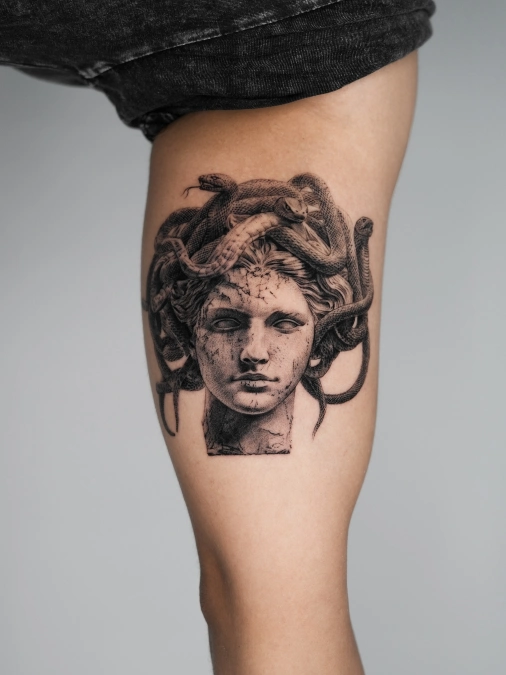
Dense, coiled snakes build a heavy textural canopy above a smooth, cracked marble face. Intense black shading pushes the writhing details straight into the foreground. Untouched skin creates the chilling illusion of cold, chalky stone.
Treating bare skin as negative space gives highly textured portraits massive structural impact.
High contrast prevents intricate focal points from blurring into a flat gray mark over the years. Aligning the vertical portrait along the bicep respects your natural muscle contours, stopping the face from warping during heavy movement.
Quick Styling Tips
- Budget version: Traditional blackwork snake designs offer serious edge for less money than hyper-realistic stone texturing.
- Renter tip: Test the exact placement using a large temporary ink transfer before committing to this demanding central focal point.
- Pro move: Extend a few subtle snake tails toward the shoulder cap to easily link this isolated piece into a future half-sleeve layout.
5. Textured Hieroglyph Portrait
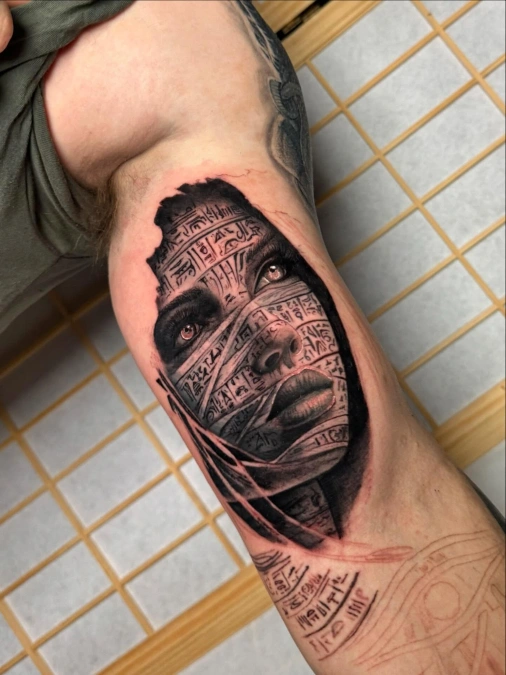
Heavy black ink creates a ragged border framing this hyper-realistic face against the soft inner arm. Crisp hieroglyphs wrap tightly across the coarse bandages, adding sharp geometric lines right next to the glossy, wet look of the eyes.
Layering harsh geometric text over soft organic features builds instant visual tension.
This high-contrast approach treats the arm like a dark, moody shadowbox, using deep borders to tightly contain the intricate line work. Wide bicep placements handle heavy framing well because the natural flat surface prevents the dark edges from visually collapsing inward.
6. Atmospheric Stormy Seascape
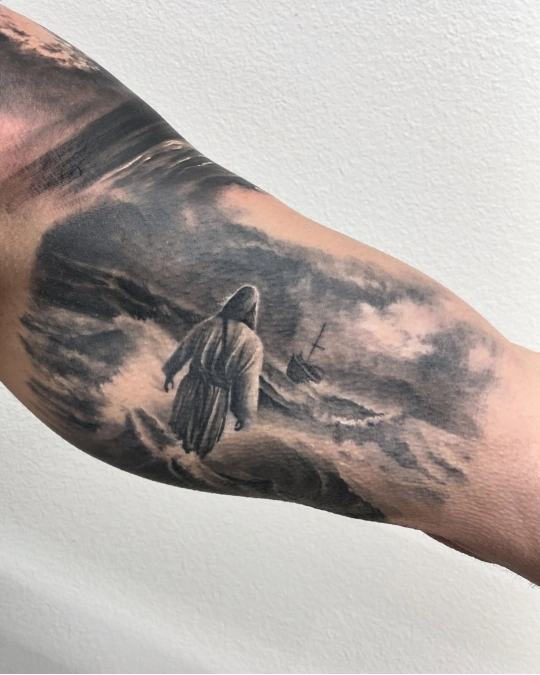
Dark charcoal clouds sweep across the upper arm, dropping into a churning, frothy sea. A solitary robed figure walks forward through the heavy waves, leaving stark white breaks in the ink.
Faded borders make heavy landscape scenes feel like natural extensions of the body rather than harsh stickers.
Treat a horizontal landscape layout like hanging a panoramic framed print on a wide living room wall. The flat inner arm prevents the horizon line from distorting when your muscle flexes.
7. Graphic Anime Character Portrait
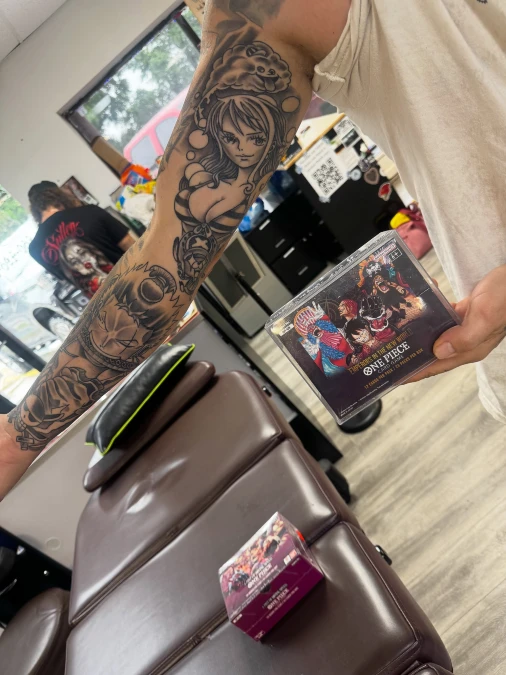
Crisp, heavy black outlines trace an expressive character portrait directly onto the smooth inner bicep. Softly shaded floating bubbles create an airy border around the figure, contrasting with her sharply defined features.
Thick structural outlines guarantee complex pop-culture illustrations remain highly readable as your skin ages.
Graphic designs require the same sturdy framework as a heavy stained-glass window. The inner arm provides a flat, protected surface that stops distinct facial features from warping when the muscle moves.
Why This Works
- Element 1: Heavy black linework builds a solid boundary that stops soft interior shading from bleeding outward.
- Element 2: Floating bubble shapes act as soft, organic framing devices to break up the rigid structure of a full sleeve.
- Element 3: Untouched skin within the face acts like a direct spotlight hitting the primary focal point.
8. Dark Moody Bison Portrait
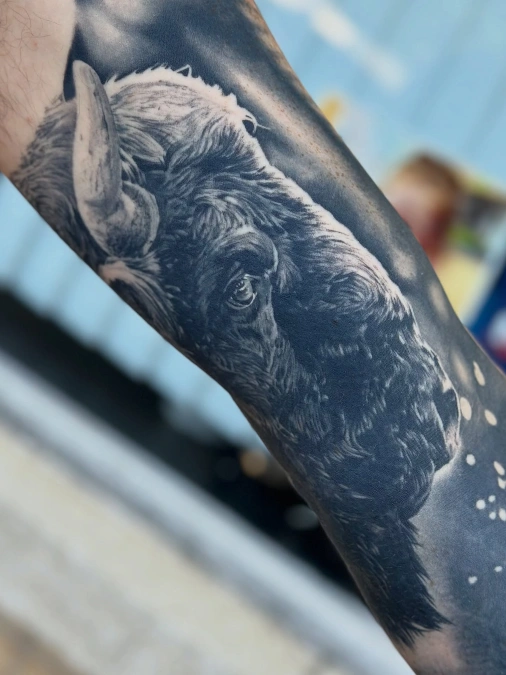
Dense black ink builds the thick, coarse fur of this majestic bison directly onto the pale inner arm. A single curved horn catches artificial light alongside the glossy, heavily shaded eye.
Heavy shading contrast turns a flat animal portrait into a deeply structural focal point.
Rustic wildlife motifs require massive visual weight to feel anchored rather than floating. The inner bicep acts as a sturdy accent wall, easily supporting the dense ink without distorting the face.
Quick Styling Tips
- Budget version: Smaller, silhouette-style wildlife stamps capture a similar rustic cabin feel without the high cost of hyper-realism.
- Renter tip: Ask your artist to map the shading contrast using a light stencil first to ensure the massive dark tones fit your exact arm shape.
- Pro move: Frame the heavy bison head with delicate negative space elements like falling snow to balance the crushing dark palette.
9. Layered Rustic Cabin Nightscape
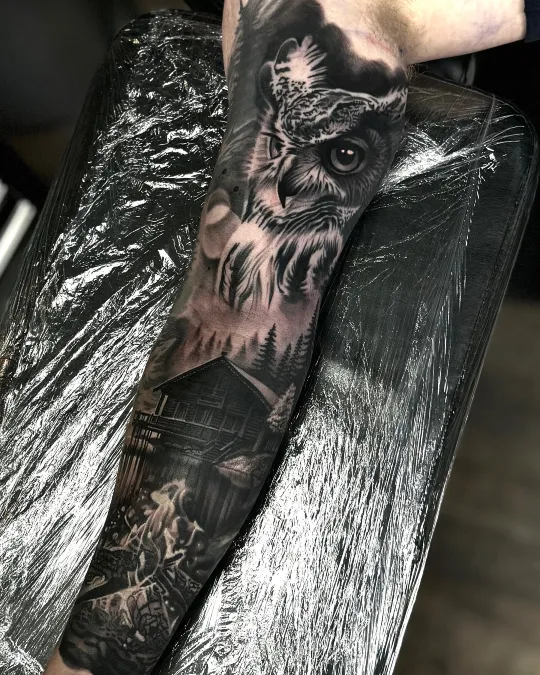
Dense charcoal ink builds a thick canopy of plush owl feathers looming over a crisp, wooden cabin. Soft grey wash mimics heavy fog rolling between sharp pine silhouettes, visually separating the bird from the grounded campfire below.
Stacking heavy foundational elements below soft, airy motifs creates a balanced floor-to-ceiling visual flow.
Treat a tall landscape layout exactly like decorating a room with dark wood floors and pale upper walls. Anchoring the darkest, heaviest shading near the bottom gives the expansive design a sturdy base to stand on.
10. Floating Geometric Glitch Hand
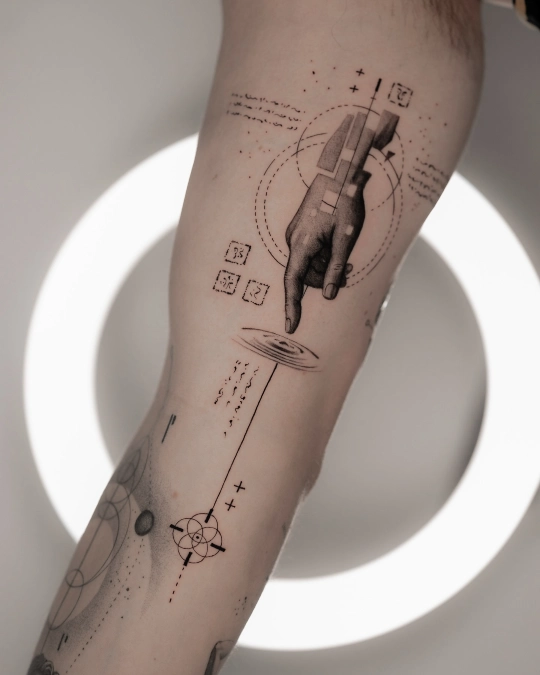
Crisp, hair-thin lines map out delicate geometry around a softly shaded hand pointing downward. A sudden pixelated glitch effect slices through the wrist, adding sharp architectural contrast to the organic fingers.
Generous negative space acts as your primary wall color, giving dense surrealist shading plenty of room to breathe.
Floating micro-tattoos require a smooth, flat foundation to maintain their crisp structure over the years. Aligning the vertical drop of the hand directly with your natural bicep contour stops the rigid geometric borders from twisting when you flex.
Quick Styling Tips
- Budget version: Swap complex micro-realism for strict fine-line geometry to cut down on chair time while keeping a highly modern look.
- Renter tip: Place these ultra-fine designs higher up near the armpit crease if you need to keep your corporate dress code intact during short-sleeve season.
- Pro move: Ask your artist to drop a single dot of bright white ink into the center of the water ripples for a massive punch of faux dimension.
11. Bold Traditional Floral Portrait
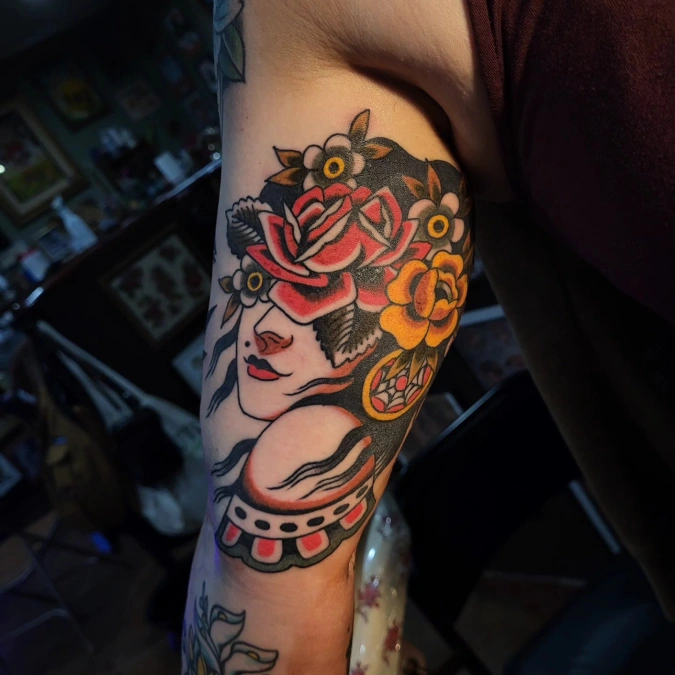
Thick black outlines build a sturdy framework holding bright, opaque primary colors. Rich crimson and marigold yellow petals burst against the dense, plush black shading filling the figure’s hair.
Heavy black frameworks lock vibrant pigments in place just like dark grout anchors a colorful mosaic tile wall.
Traditional styling requires massive visual weight to stand the test of time. The soft inner bicep provides a reliable, flat surface that stops these solid color blocks from warping.
12. Opaque Vintage Floral Portrait
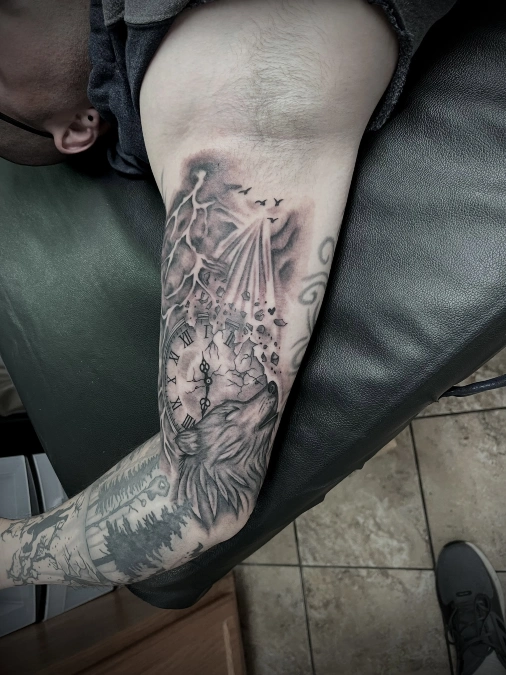
Heavy black ink creates a dense, plush background for this vintage-inspired lady head. Crisp crimson and warm marigold petals jump sharply against the pale inner arm.
Dense color packing requires a solid black anchor to stop bright pigments from floating aimlessly.
Traditional styling works incredibly well on flat, protected skin because the bold shades avoid harsh sun damage. Treat this specific layout exactly like hanging a highly saturated pop art canvas.
Why This Works
- Element 1: Solid black framing locks the bright primary colors firmly into the skin layout.
- Element 2: Generous negative space inside the facial features adds necessary lightness to balance the crushing dark hair.
- Element 3: Round floral shapes contour naturally around the bicep muscle to prevent awkward visual warping.
13. High Contrast Classical Marble Sculptures
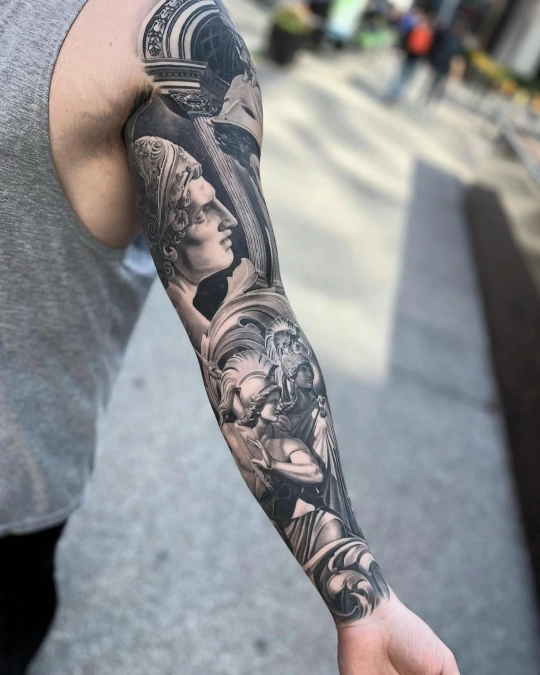
Dense black backgrounds push these smooth, chalky stone faces directly into the foreground of the inner arm. Sharp architectural columns run vertically along the bicep, mimicking grand gallery pillars.
Framing pure, untouched skin against massive fields of black ink creates the striking illusion of cold, hard stone.
Highly detailed realism demands massive contrast to survive the aging process without muddying. Treat this complex layout like placing heavy stone busts inside a stark, dark-painted room to force attention onto the primary subject.
14. Sweeping Custom Script Typography
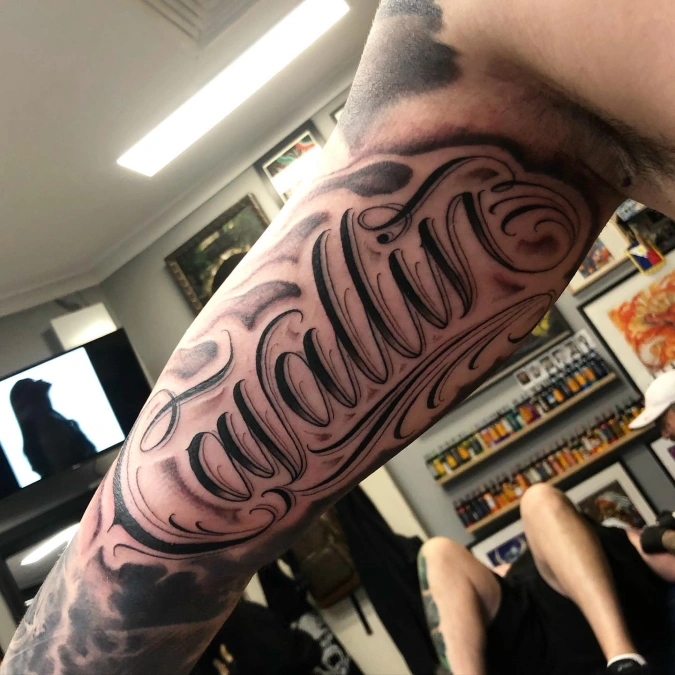
Massive black letters sweep aggressively across the pale inner bicep. Soft charcoal shading builds a heavy drop shadow behind the bold, swooping script. Untouched skin breaks through the dense background clouds to give the crisp calligraphy deep structural dimension.
Heavy drop shadows turn flat text into massive architectural statement pieces.
Script requires generous sizing to stop the ink loops from closing up as your skin ages. The flat bicep provides a highly stable wall for oversized lettering to stretch out cleanly without distortion.
Why This Works
- Element 1: Thick black lettering builds a rigid skeleton that resists blurring over the years.
- Element 2: Charcoal background shading forces the lighter, untouched skin to visually pop straight forward.
- Element 3: Sweeping filigree tails contour smoothly around the natural curve of the arm muscle to create a tailored fit.
15. Ornate Filigree Framed Hands
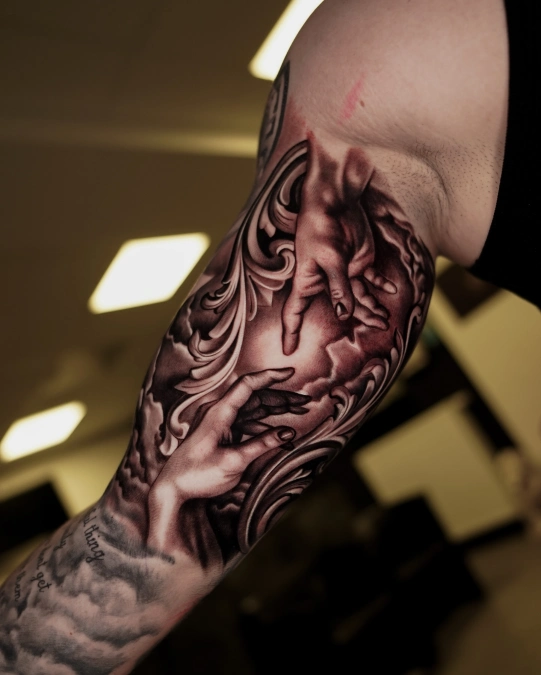
Ornate baroque filigree creates a heavy sculpted border around two reaching hands. Deep charcoal clouds fill the background to push the smooth skin tones straight into the foreground.
Heavy decorative borders tightly contain soft focal points to stop complex shading from muddying outward.
Framing soft realism with rigid ornamental shapes builds strict structural boundaries for the ink. The inner bicep handles this dense black and grey composition well because the flat canvas prevents the intricate filigree from warping over time.
Quick Styling Tips
- Budget version: Swap the hyper-realistic hands for a simple negative space silhouette to capture the heavy, moody vibe for less.
- Renter tip: Test a temporary transfer of thick filigree patterns first to see exactly how the dense borders interact with your arm shape.
- Pro move: Extend the dark charcoal clouds upward toward the shoulder cap to easily link this isolated piece into a full black and grey sleeve later.
16. Structured Geometric Tribal Weave
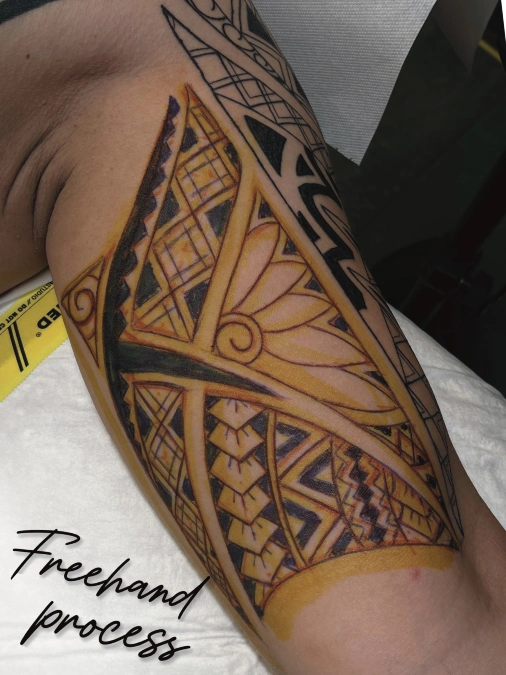
Dense black ink locks into tight, repeating geometric grids across the pale inner arm. Sharp triangles and woven spearhead motifs mimic the heavy, grounding texture of a tightly loomed rug.
Strict repeating patterns deliver massive visual weight without looking cluttered or messy.
Treat this highly repetitive layout exactly like installing a bold graphic tile floor in a minimalist bathroom. The rigid structural framework keeps complex visual information looking incredibly clean as the ink ages.
17. Layered Heirloom Pocket Watch and Print
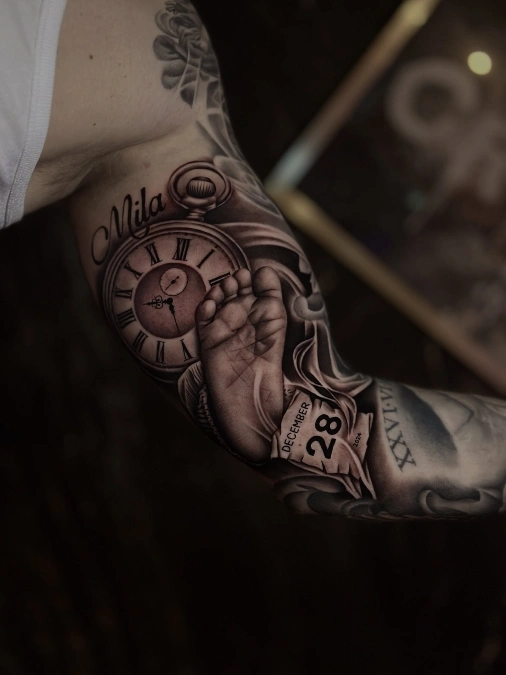
Heavy charcoal ink builds a plush background behind a crisp pocket watch and a textured baby footprint. Bright negative space highlights the delicate script name and date banner resting near the elbow.
Framing soft organic textures with rigid geometric shapes creates a grounded, structured shadowbox effect.
Treat this highly sentimental layout exactly like hanging a framed heirloom gallery in a warm den. You need firm boundaries to keep intricate grey shading from blurring into a messy cloud over time.
18. Cinematic Tactical Skull Portrait
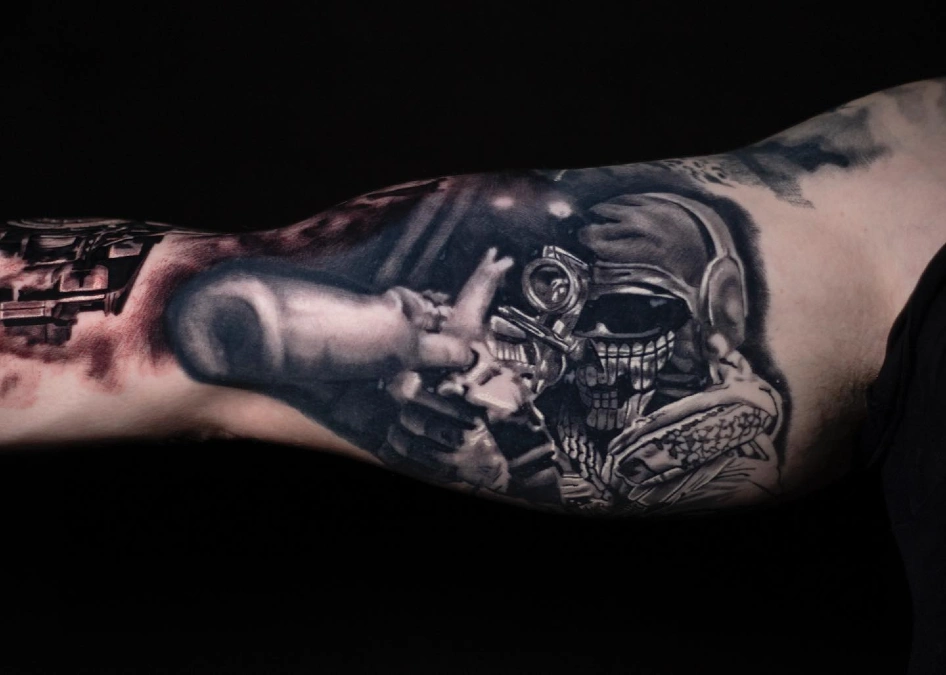
Dense black ink floods the background of this tactical soldier portrait, creating a plush cinematic darkness across the inner arm. Crisp negative space cuts through the heavy shading to illuminate the stark teeth of the skull mask and the slick metallic rifle scope.
Extreme shading contrast relies heavily on untouched skin to prevent complex scenes from blurring into a flat shadow over time.
Treating this heavy realism like a massive statement canvas requires strict attention to muscle contour alignment so the horizontal gun barrel does not warp when you move.
Why This Works
- Element 1: Massive fields of dense black background ink act as a structural wall that pushes the lighter foreground features straight toward the eye.
- Element 2: Bright highlights built entirely from bare skin keep the highly textured combat gear from feeling visually heavy.
- Element 3: Running the rigid linear rifle shape parallel to the natural flex point of the bicep guarantees the art moves cleanly alongside the body.
19. Structural Eagle and Greek Key Border
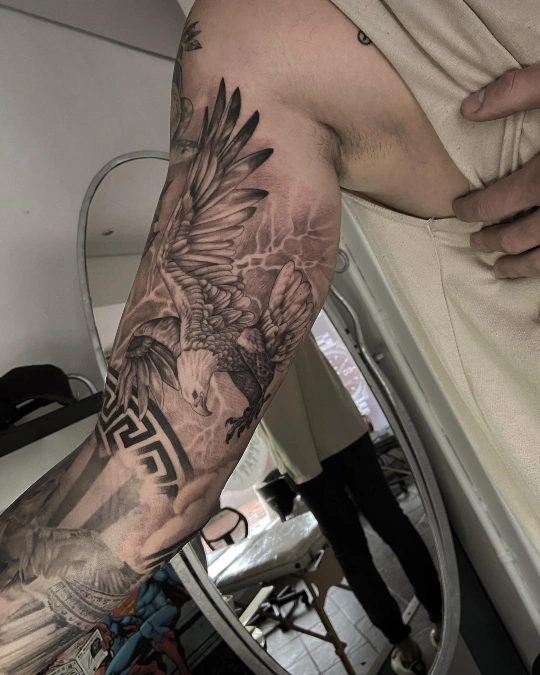
Crisp black ink builds a heavy Greek key border. This grounds the lower arm like solid dark wainscoting in a formal dining room. Above this rigid foundation, a detailed eagle glides through soft, plush charcoal clouds.
Anchoring dynamic overhead elements with rigid geometric borders creates serious structural balance.
High-movement subjects like soaring birds need heavy framing. This firm boundary keeps the intricate layout from feeling chaotic as the ink settles over the decades.