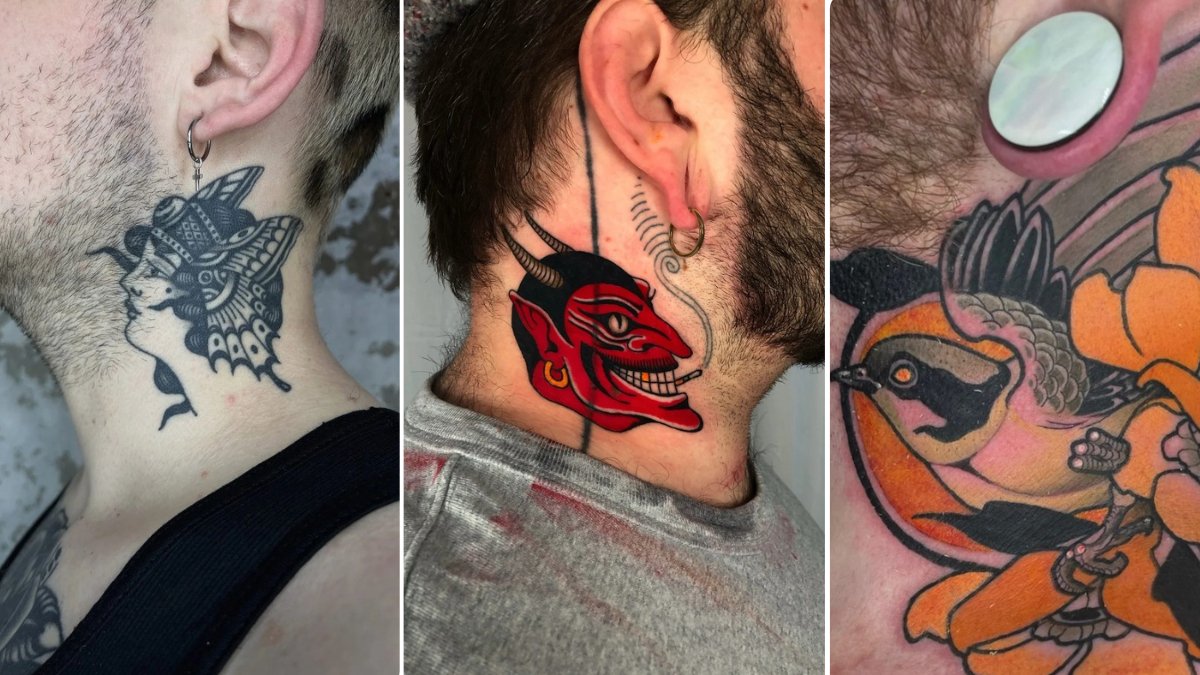
Neck tattoo ideas for men range from a small script behind the ear to a full throat piece that frames the jaw. Because the neck is so hard to hide, these designs are a serious commitment, so the placement, size and style matter as much as the artwork itself.
Exploring these 19 Neck Tattoos Ideas for Men Who Fully Committed to the Life requires supreme confidence. Heavy throat pieces function as undeniable anchors for your personal presentation.
Framing the Jawline Permanent Design Tactics
Treating your neck as a primary canvas changes your entire wardrobe strategy. Heavy shading demands simpler clothing choices to avoid visual clutter and maintain balance.
Open collars and crewnecks become your structural framing elements. Deep ink tones require deliberate daily care to keep the edges crisp against the natural skin backdrop.
1. Structured Red Devil With Linear Anchor
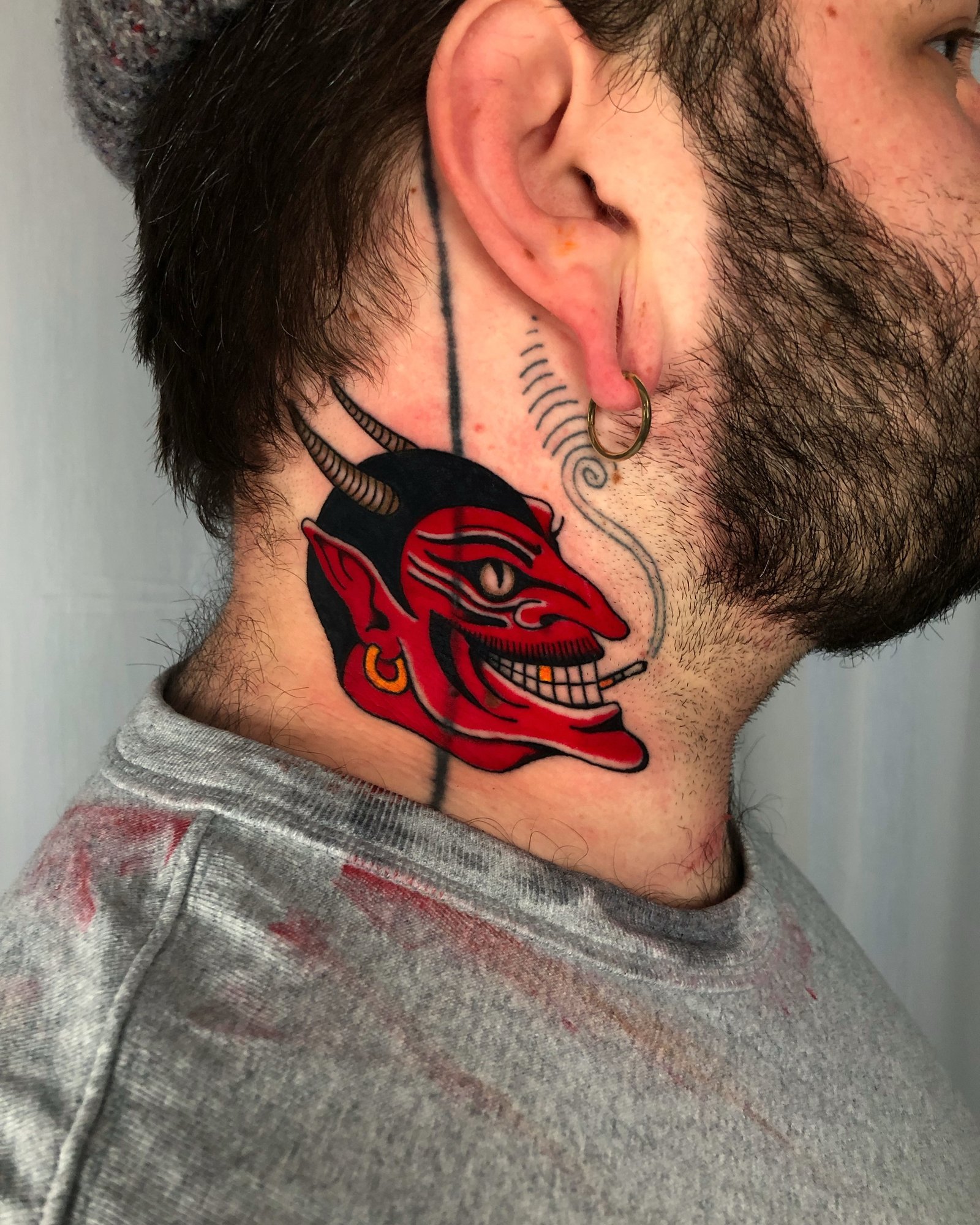
Crisp black outlines frame a saturated red devil head on the side of the neck. A stark, vertical black line drops down from the hairline, intersecting the artwork like a structural steel beam.
Running a thick vertical line through a colorful piece anchors the entire design. This geometric trick keeps the intense red ink from floating aimlessly on bare skin.
2. Blackwork Butterfly Lady Profile
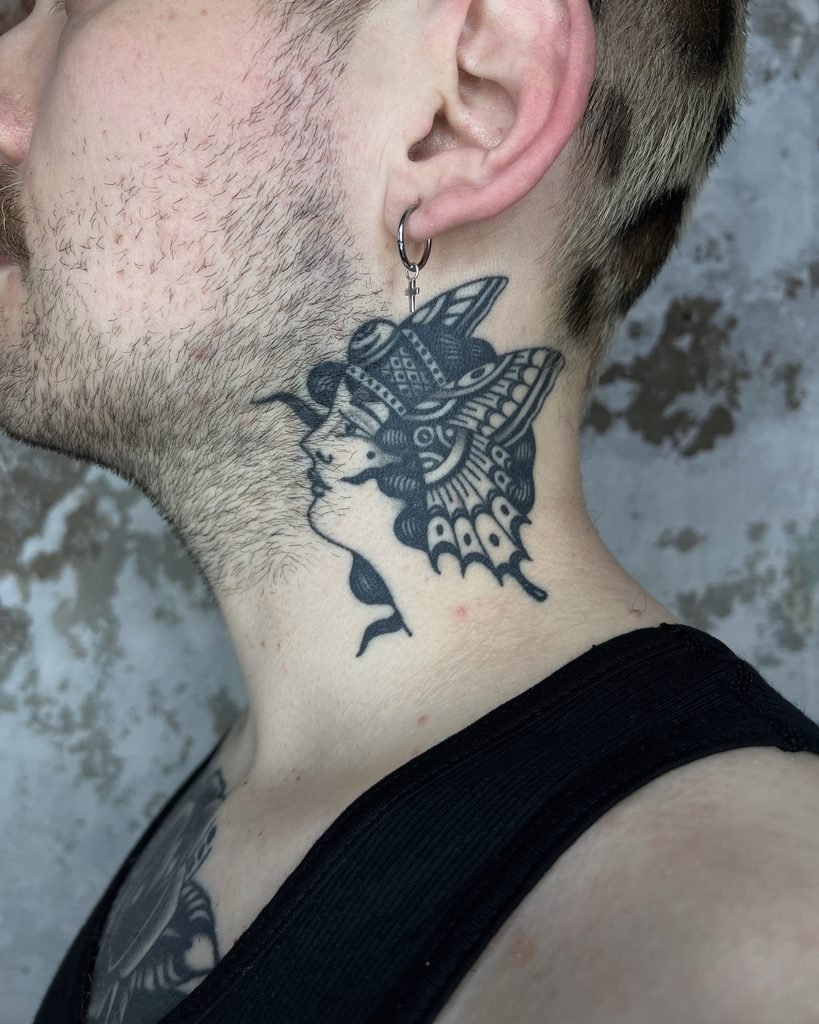
Dense black ink forms a crisp profile of a woman morphing into a patterned butterfly wing on the side of the neck. Whip-shaded textures fill the interior scales, creating soft visual gradients against her solid, heavy hair.
High-contrast blackwork acts like heavy velvet drapes, absorbing light and grounding the entire look.
Placing a dense, dark motif directly under the ear creates a strong structural anchor point.
3. Lush Flora and Fauna with Surprising Hues
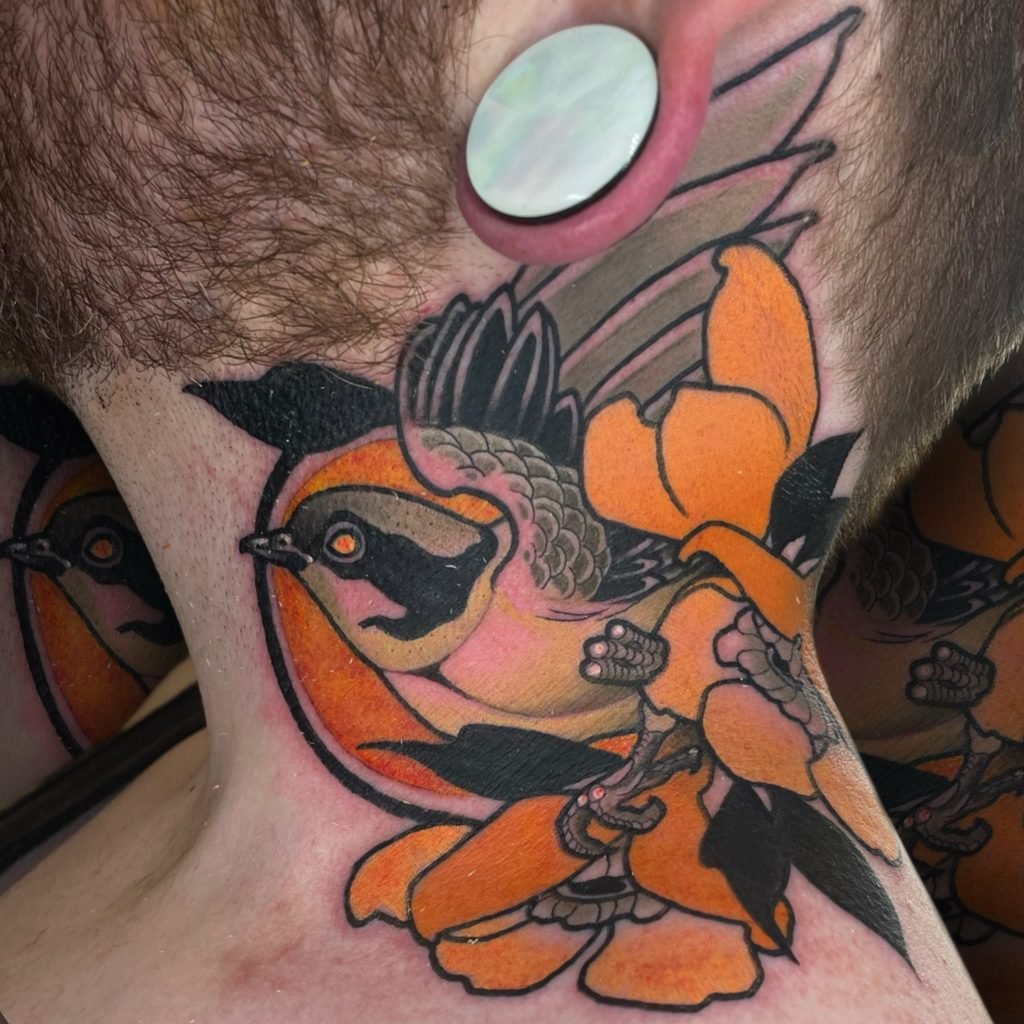
Soft pink and warm orange tones saturate a chickadee-like bird sitting surrounded by vibrant orange flora. Textured, muted grey abstract leaf-like forms layer beneath the main subject, giving the piece unexpected sculptural depth.
Layering vibrant primary subjects over muted, textural background shapes is a classic formula for visual interest. Why This Works
- Vibrant Color Fusion: The specific combination of saturated pink and punchy orange gives traditional bird motifs a modern, unexpected energy.
- Integrated Florals: Layering continuous orange flowers flows naturally down the neck, making the design feel like an organic extension of the skin.
- Textural Background Elements: Large, abstract grey/brown shapes provide essential structural grounding and necessary visual breathing room behind the intense color blocks.
4. Symmetrical Laurel Wreath Collar Framing
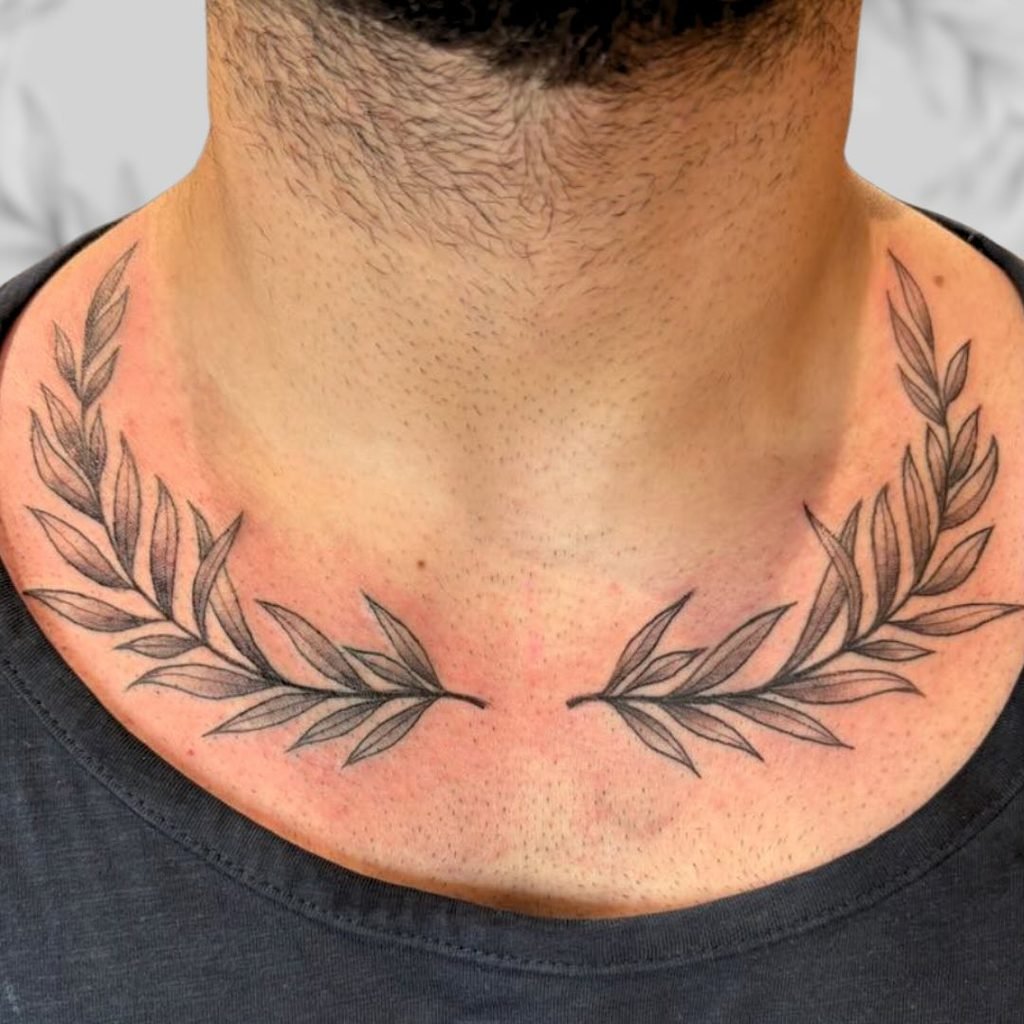
Fine line laurel branches extend symmetrically across the lower neck and collarbones, pointing inward toward the center gap. Soft grey shading creates gentle depth along each leaf vein.
Symmetrical greenery frames the collarbone like a crisp architectural arch.
Placing delicate leaf strands around the lower throat acts like installing a minimalist crown molding in a sunlit dining area. Clean horizontal symmetry balances natural neck movement without overpowering your jawline.
5. Feathered Wing Arch along the Jawline
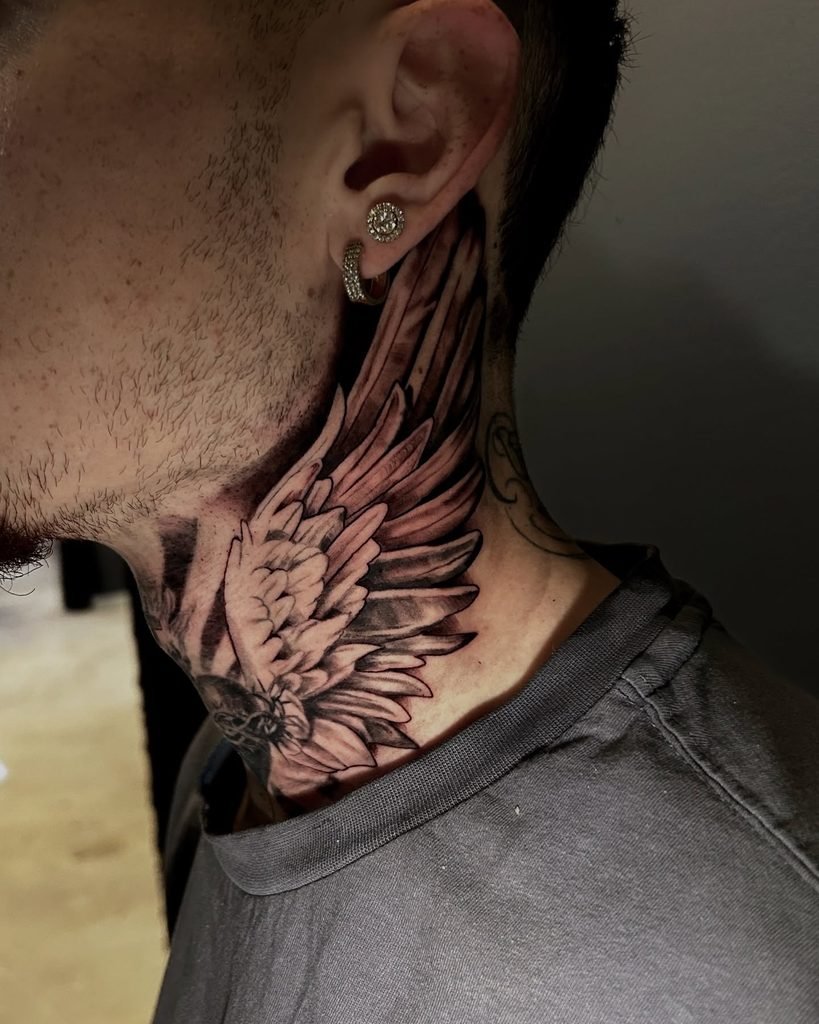
Layered white and charcoal feathers sweep upward toward the earlobe in dramatic, soft gradients. Deep black shading anchors the top tips behind the ear, while smooth grey tones give each feather a soft, plush dimension.
Soft feathering softens hard architectural angles while maintaining strong visual structure.
Curving organic shapes across the neck tendon soften sharp facial bone structure. This technique mirrors hanging plush linen drapery against raw concrete walls to warm up an industrial interior.
Quick Styling Tips
- Budget version: Opt for single-wing placement on one side rather than full throat wraps to cut chair time in half.
- Pro tip: Keep open-neck shirts in heavy rotation so the delicate wing tips remain visible without friction.
- Pro move: Add subtle white ink highlights along the top feather ridge for extra three-dimensional pop under direct light.
6. Text and Botanical Framing Across the Collar
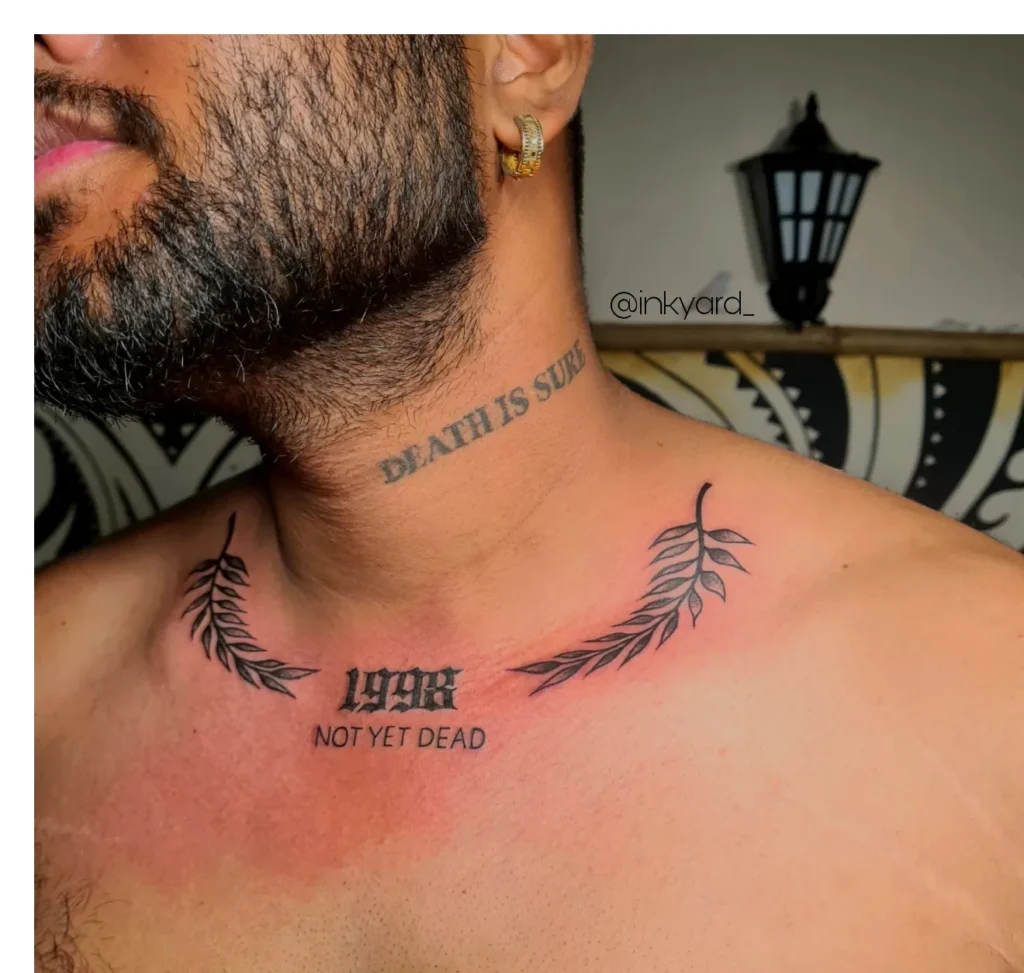
Crisp black script reading “DEATH IS SURE” wraps gracefully along the side of the throat. Symmetrical botanical branches frame a heavy Old English “1998” and smaller text positioned right at the center collarbone.
Pairing sharp typography with organic leaf shapes creates essential structural balance.
Breaking up heavy lettering with curved branches keeps the layout from reading too aggressively.
7. Ruby Cross With Radiating Shadow Beams
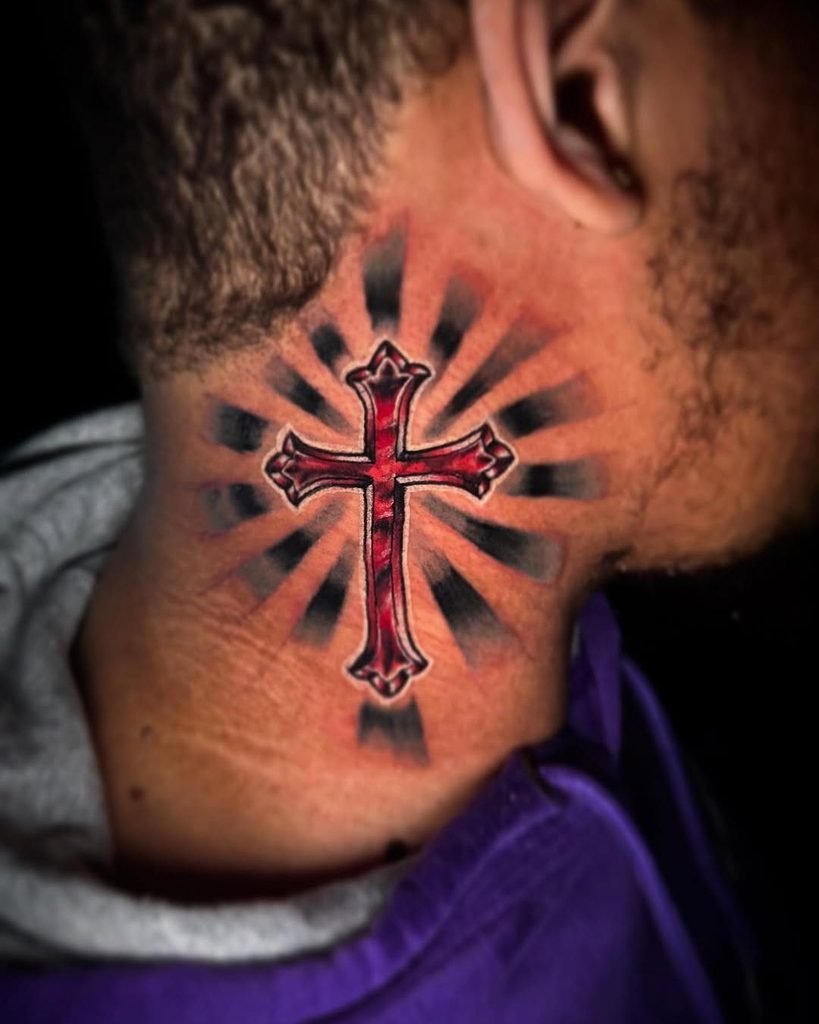
Deep ruby red ink fills the center of a heavily structured cross positioned on the side of the neck. Soft black and grey beams radiate outward from the core shape, building a moody halo effect.
Framing vivid colors with stark white borders acts exactly like installing hidden backlighting behind a heavy gallery frame.
Grounding highly saturated ink requires careful contrast to prevent visual flatness. The diffused grey rays function just like applying matte charcoal paint behind a rich red velvet accent piece.
Why This Works
- White boundary lines: A tight un-inked outline forces the primary red cross to jump forward visually.
- Textured color fill: Internal shading variations mimic faceted glass, keeping the large red blocks from looking flat.
- Diffused background rays: Soft outward gradients provide a critical transition from dense black edges into the natural skin tone.
8. Realistic Crowned Portrait With Bold Framing
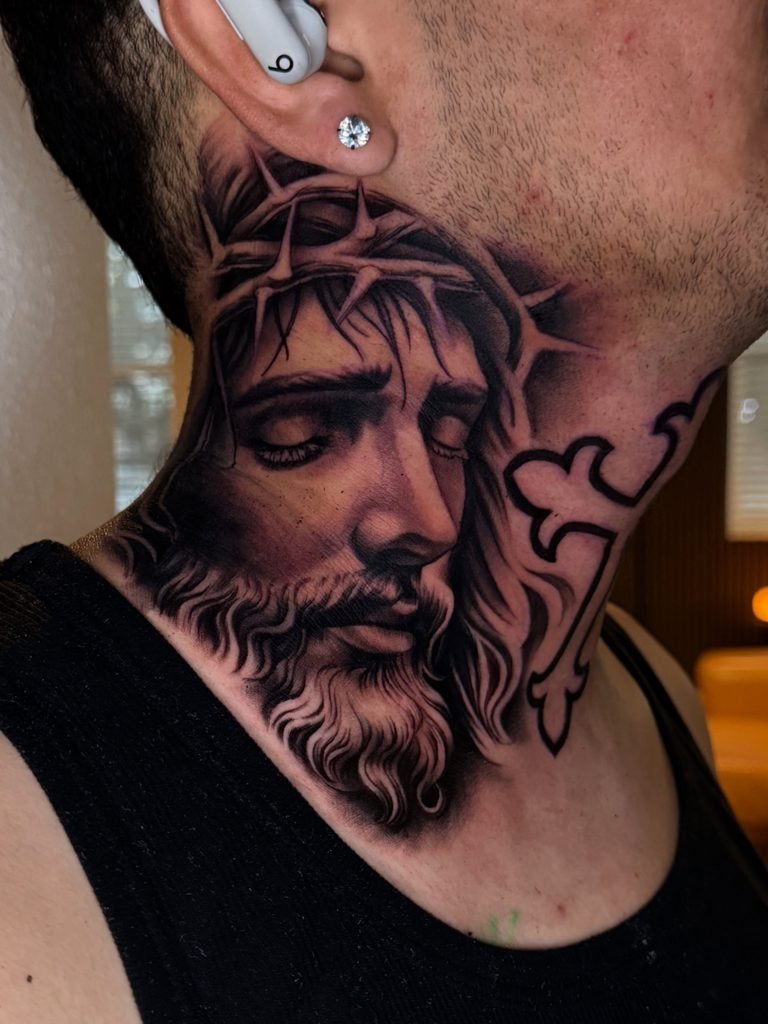
Dense black and grey shading constructs a highly detailed portrait of Jesus wearing a textured crown of thorns on the side of the neck. A thick graphic outline forms a stylized cross at the front of the throat, providing rigid structural framing against the soft portrait artwork.
Mixing hyper-realistic shading with heavy graphic outlines creates immediate visual tension.
Contrast serves as the core design formula for large-scale physical canvases. Treat soft portraiture like styling a plush velvet armchair against a raw concrete wall.
9. Negative Space Geometric Floral Back Collar
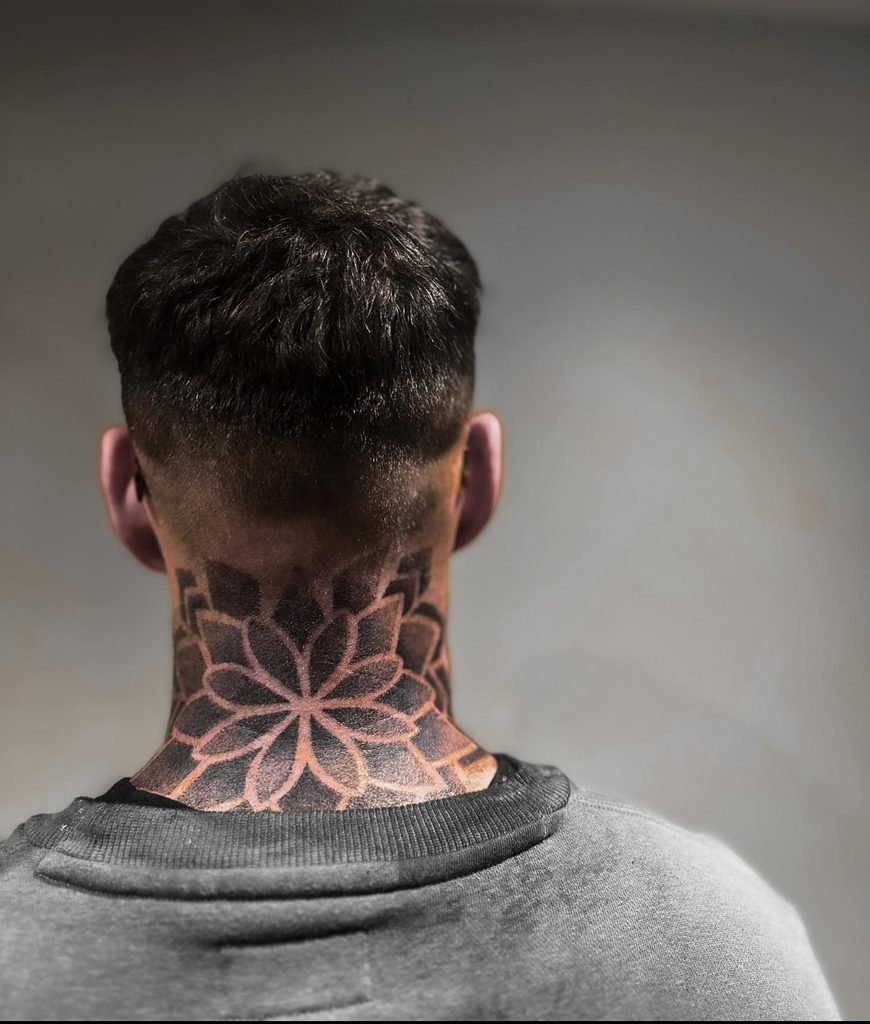
Heavy black dotwork builds a deep, textured background across the back of the neck. Bare skin forms crisp, symmetrical petals blooming outward from the center spine.
High-contrast geometric patterns require precise placement to maintain symmetry as the body moves.
Quick Styling Tips
- Budget version: Scale the outer rings down to focus entirely on the central floral star for quicker execution.
- Pro tip: Wear collared jackets or standard crewnecks when you need to completely obscure the piece from behind.
- Pro move: Coordinate your barber visits closely with your artist so the skin fade always blends smoothly into the top gradient.
10. Roaring Tiger Profile With High Contrast Shading
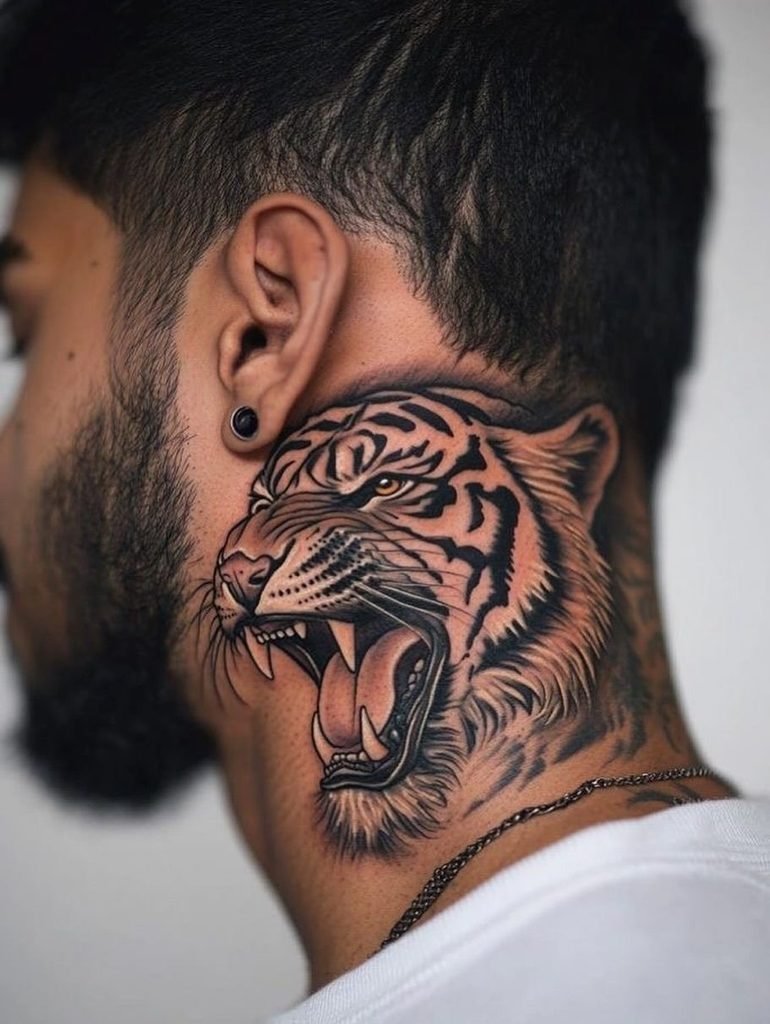
Crisp black stripes cut through soft grey fur textures, building a fierce roaring tiger directly under the earlobe.Warm natural skin tones act as negative space, giving the heavy shading a grounded, breathable dimension.
Positioning an open mouth facing forward harnesses the natural kinetic energy of your jawline.
Quick Styling Tips
- Budget version: Choose a closed-mouth big cat design to reduce complex inner-jaw detailing and cut down chair time.
- Pro tip: Keep the entire piece strictly on the lower neck so standard winter collars conceal the teeth during formal hours.
- Pro move: Drop subtle yellow pigment into the eye irises for a sharp visual anchor that catches direct light.
11. Masked Figure With Winged Collar Extension
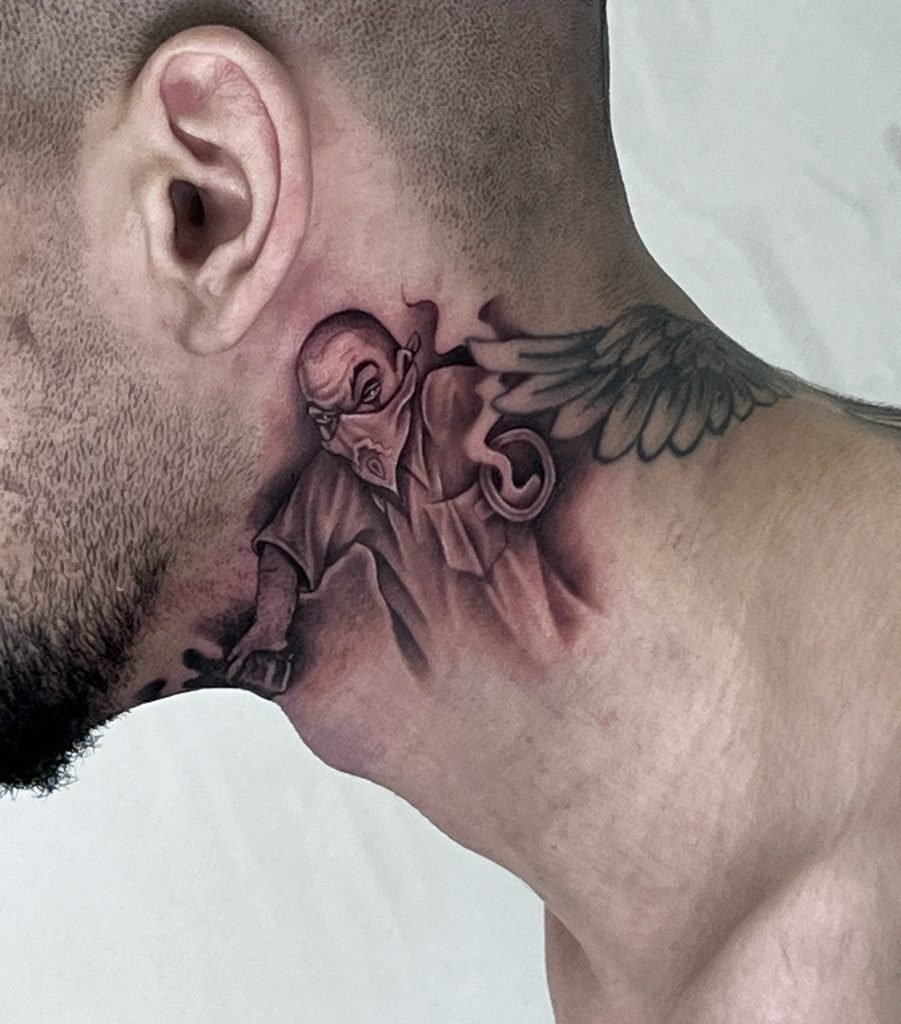
Smooth charcoal shading forms a masked street figure wearing a crisp collared shirt right below the earlobe. Diffuse smoky gradients surround the bold subject, fading the heavy street-style art into bare skin.
Grounding intense portraiture requires soft transitional borders to avoid a rigid sticker effect. Men seeking aggressive front-facing motifs should stretch supporting elements backward to maintain visual balance across the collar.
Why This Works
- Smoky Backgrounds: Soft grey drop-shadows anchor the rigid character securely against the natural neck contours.
- Sweeping Wings: Extending feathers backward pulls visual weight away from the jawline to prevent top-heavy crowding.
- Fabric Textures: Shading crisp folds into the clothing adds essential realism to an otherwise flat graphic shape.
12. Minimalist Fine Line Dagger Portrait
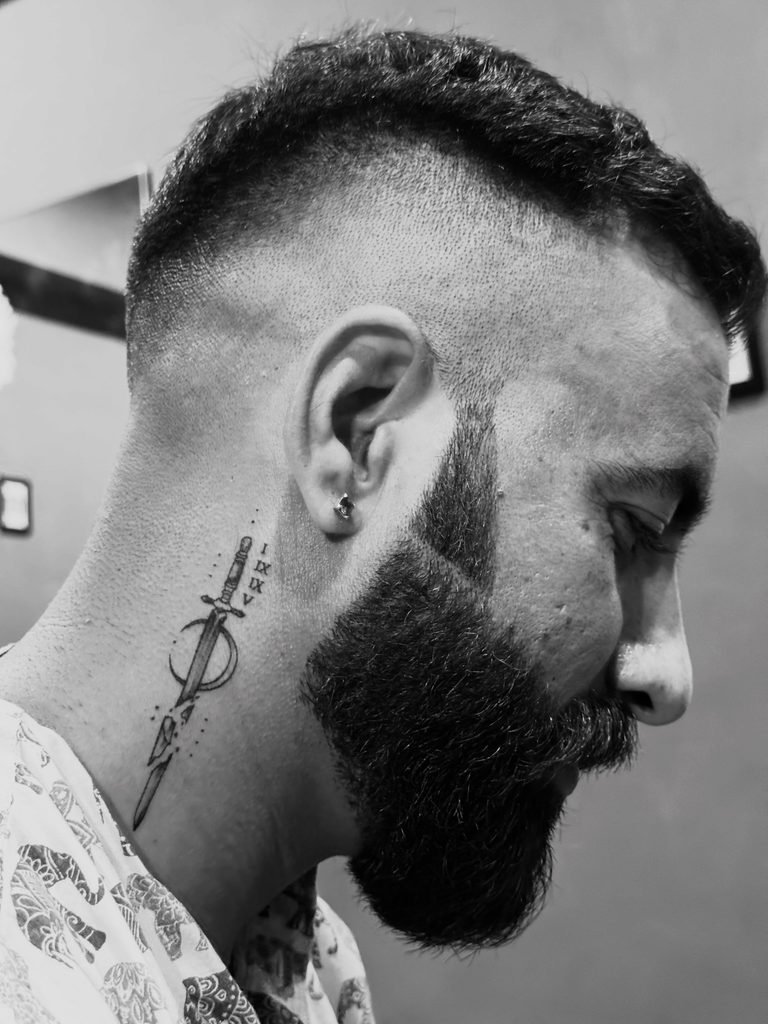
Crisp black ink forms a delicate dagger pointing straight down behind the earlobe. Tiny Roman numerals and subtle stippling dot the surrounding bare skin, creating an airy, weightless composition.
Placing thin, linear art behind the jaw structure capitalizes beautifully on the natural contours of your neck.
13. Winged Cross Nape Design with Cursive Script
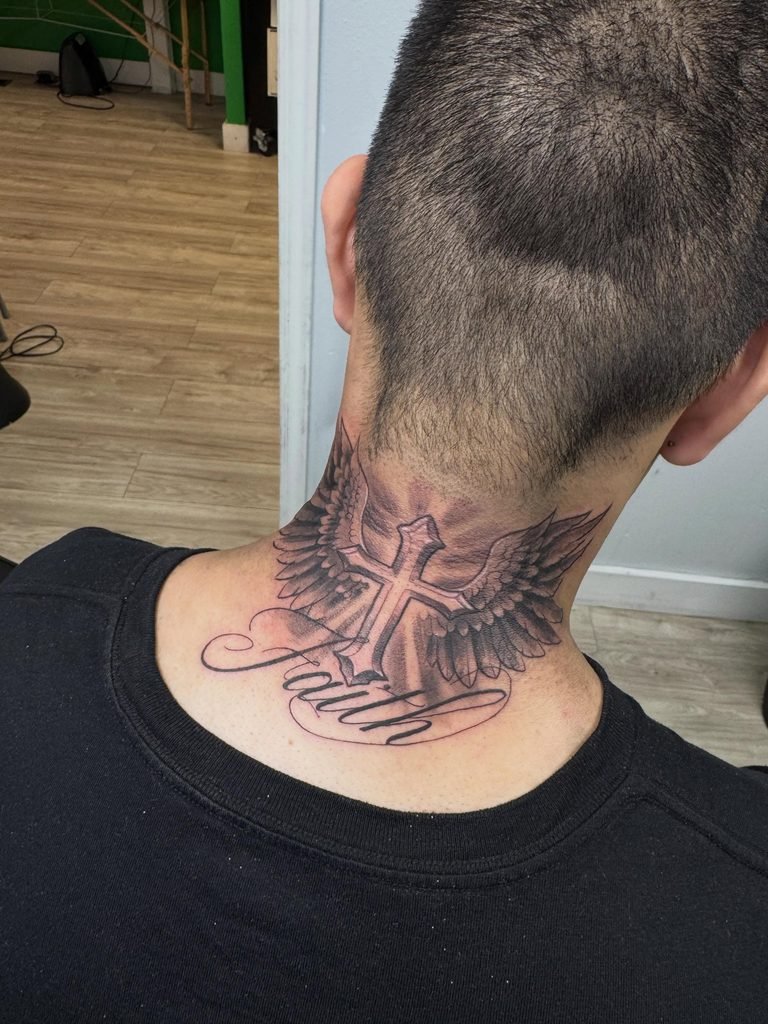
Soft grey rays radiate behind a centered cross flanked by feathered wings at the nape of the neck. Crisp cursive script spelling “Faith” loops smoothly across the lower boundary.
Centering symmetrical motifs along the spine creates a grounded architectural anchor.
Placing symmetrical artwork low on the nape keeps the design subtle from the front while providing impact from behind. Men wanting meaningful symbolism without disrupting front-facing jawline aesthetics benefit greatly from this back-neck framework.
Quick Styling Tips
- Budget version: Focus solely on the winged cross motif to reduce session time and lower overall cost.
- Pro tip: Wear standard collared shirts to keep the entire back piece completely hidden during work hours.
- Pro move: Pair this nape piece with a high skin fade haircut to maximize contrast against the top shading.
14. Roaring Irezumi Tiger With Heavy Ink Shading
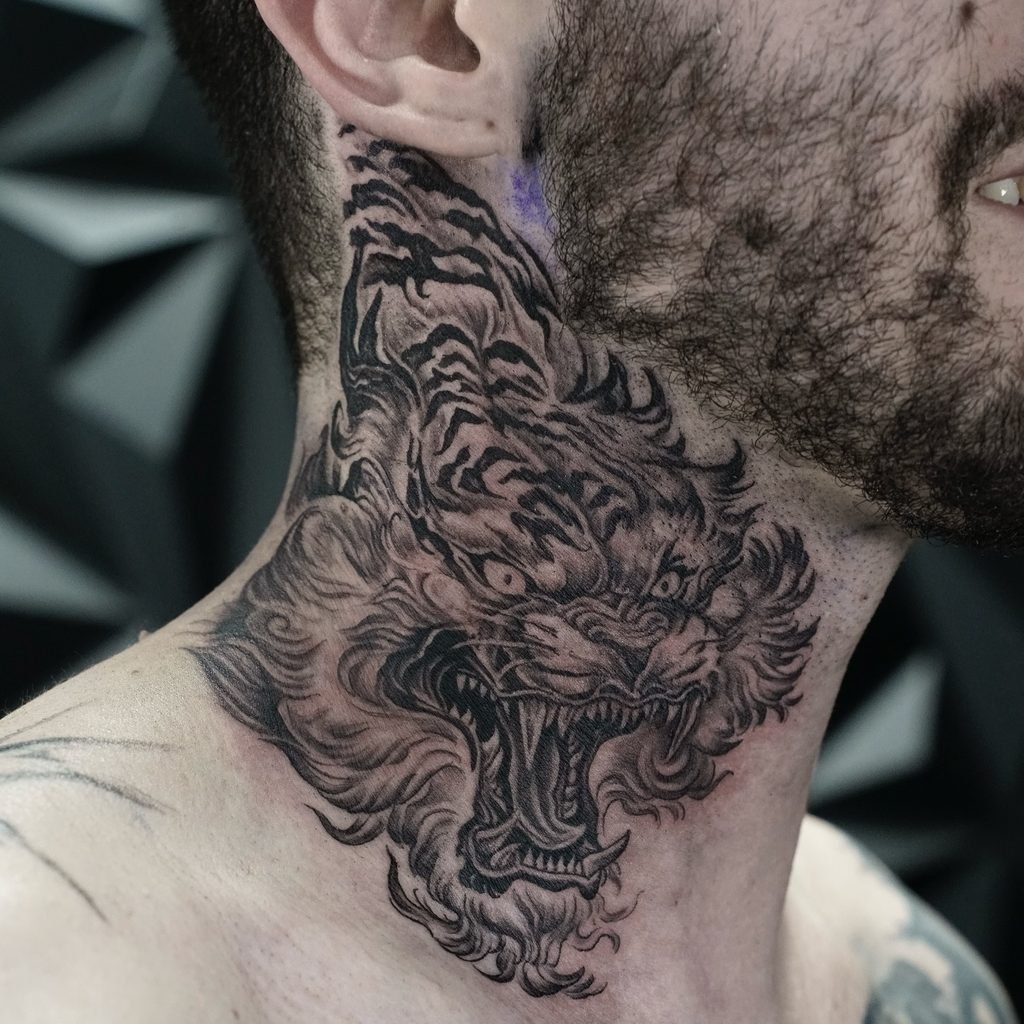
Dense black ink creates a fierce Japanese-style tiger covering the entire side of the neck. Light strikes the bare skin, pushing the heavy charcoal shading forward into sharp relief.
Adapting classic Japanese Irezumi design for the throat requires bold commitment. Men embracing this intense look should wear neutral, crisp shirts to let the raw linework breathe.
Why This Works
- Element 1: Thick outlining locks the complex fur patterns firmly in place against the jawline.
- Element 2: Flowing shape structures follow the natural throat tendons to create organic movement.
- Element 3: Un-inked negative space prevents the dense black shading from looking muddy or flat.
15. Geometric Blackwork Eye With Linear Axis
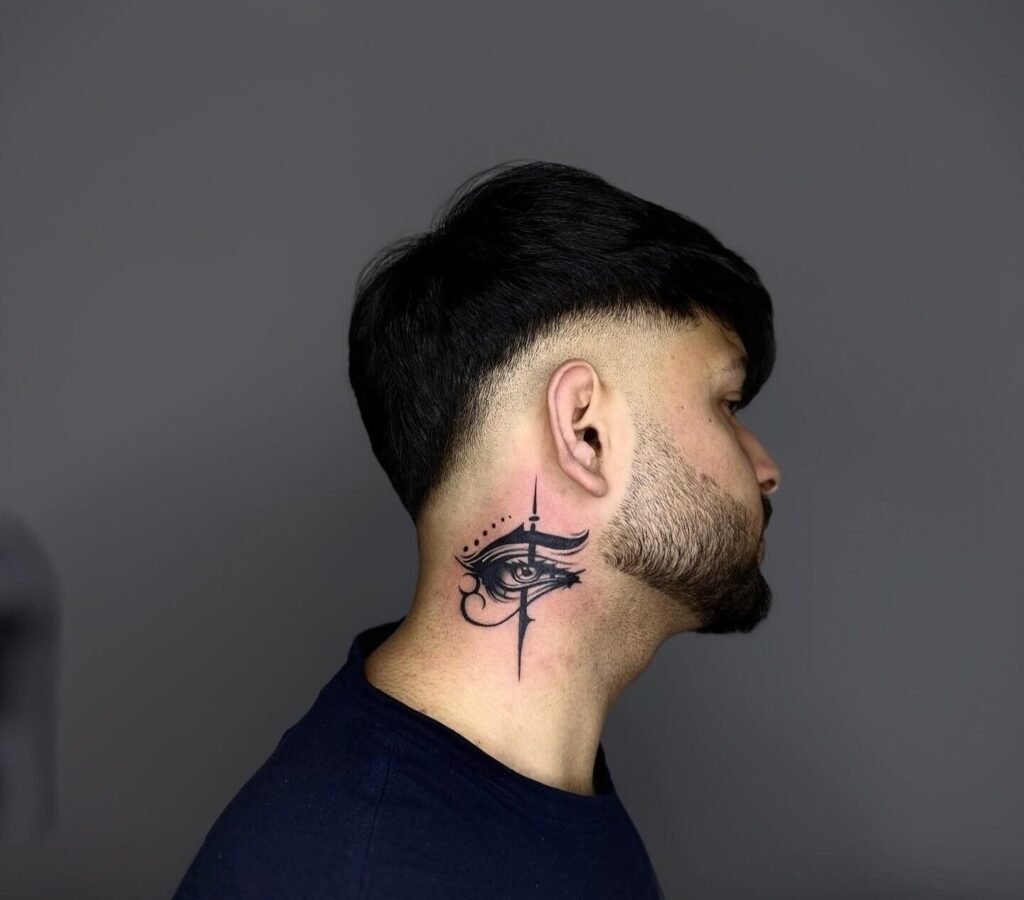
Crisp solid black ink forms a stylized eye motif directly below a sharp skin fade haircut. Studio light highlights the clean negative space resting between the dark lashes and intricate dotted accents.
Sharp linear elements require precise structural placement to prevent the artwork from floating aimlessly on bare skin. Grounding a fluid shape with a hard vertical axis provides immediate visual stability.
16. Ornate Baroque Filigree Full Collar
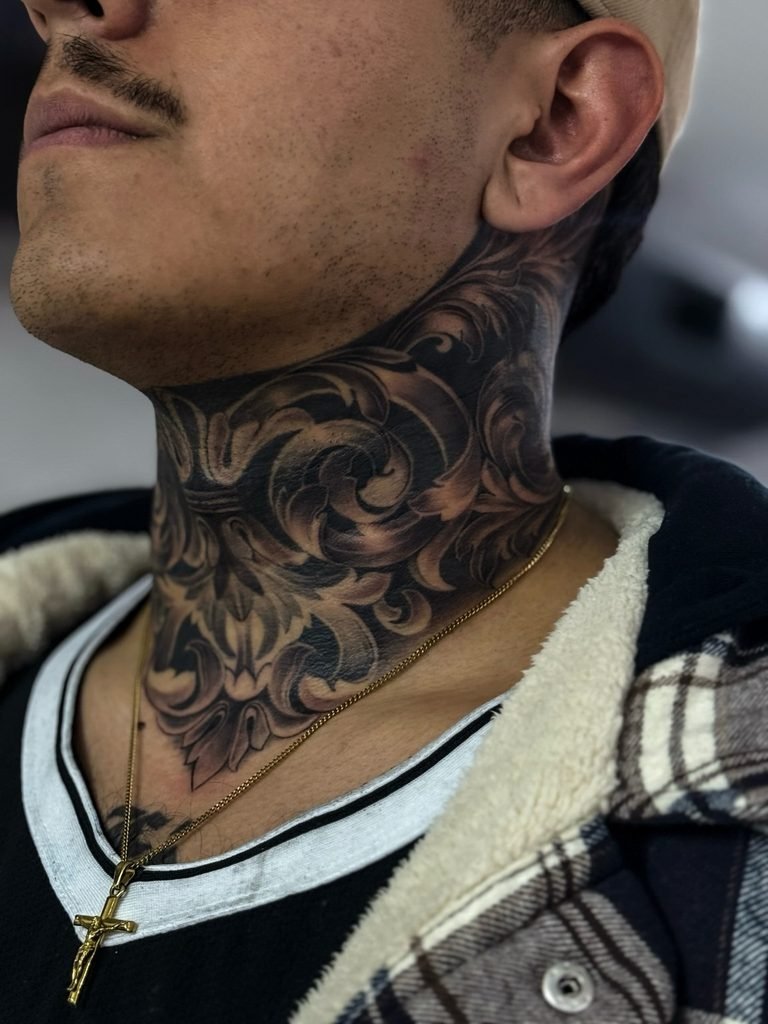
Deep black shading builds intricate ornamental filigree patterns covering the entire front of the throat. The artwork dips below the neckline, resting quietly behind a layered gold crucifix chain.
Full-coverage dark pieces demand total commitment to serious visual weight. . Men wearing heavy baroque collars need simple, unpatterned shirts to keep the intricate linework grounded.
Quick Styling Tips
- Budget version: Scale the filigree down to a single central throat medallion to cut your chair time in half.
- Pro tip: Test this massive layout with a temporary custom stencil before committing to the permanent dark work.
- Pro move: Layer a heavy solid gold chain over the collarbone to break up the sprawling grey gradients.
17. Vertical Script With Flying Bird Silhouettes
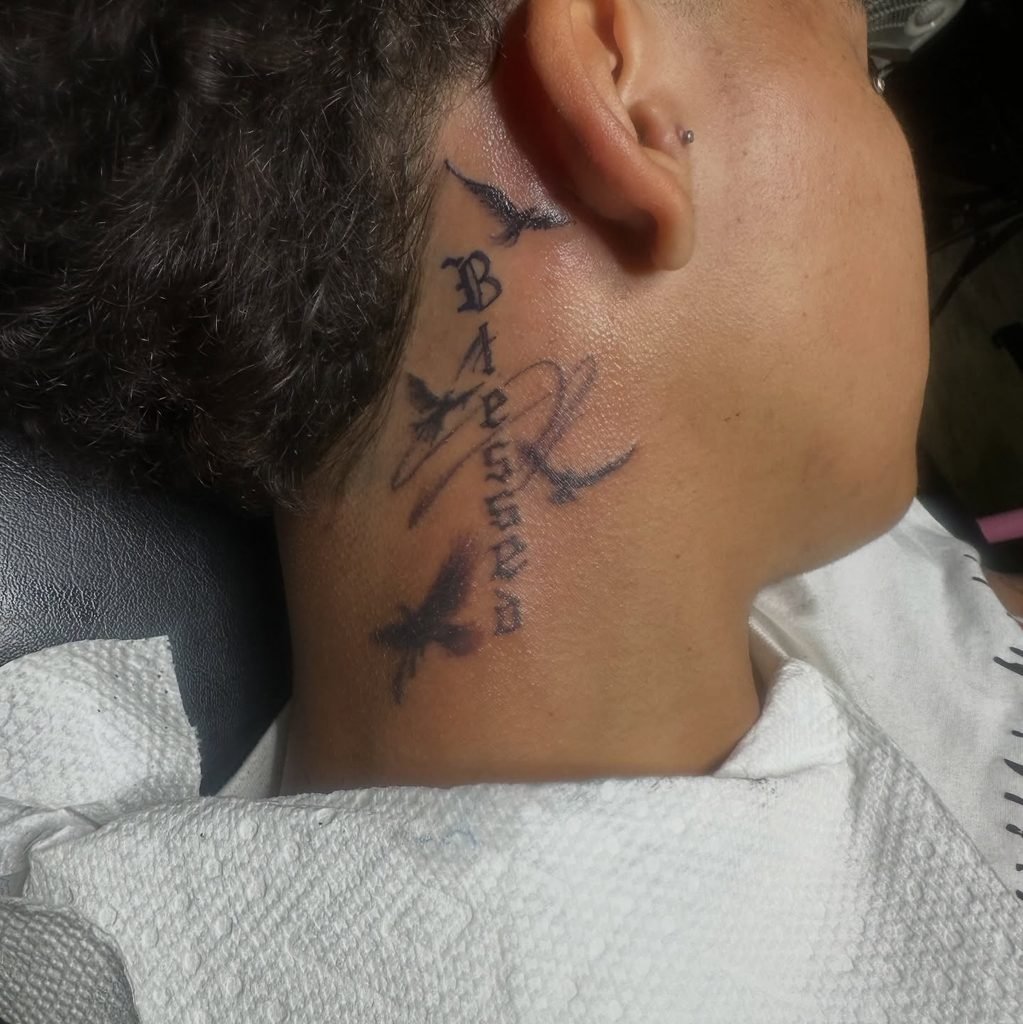
Vertical typography creates a natural lengthening effect that turns simple lettering into an architectural feature.
Crisp black Old English script spells “Blessed” vertically along the muscle line behind the earlobe. Delicate grey script loops fluidly through the center, adding layered, airy depth to the dark typography.
Stacking text along the natural neck tendon acts like hanging a long, narrow tapestry in a tall entry gallery. S Men choosing vertical script should pair it with open collar shirts to showcase the full linear flow.
Why This Works
- Element 1: Vertical text placement follows natural muscle contours to streamline the side profile.
- Element 2: Silhouetted bird shapes soften the rigid, angular edges of traditional Old English lettering.
- Element 3: Layering faint background script creates a rich multi-dimensional effect on bare skin.
18. Centered Script With Scalloped Shadow Framing
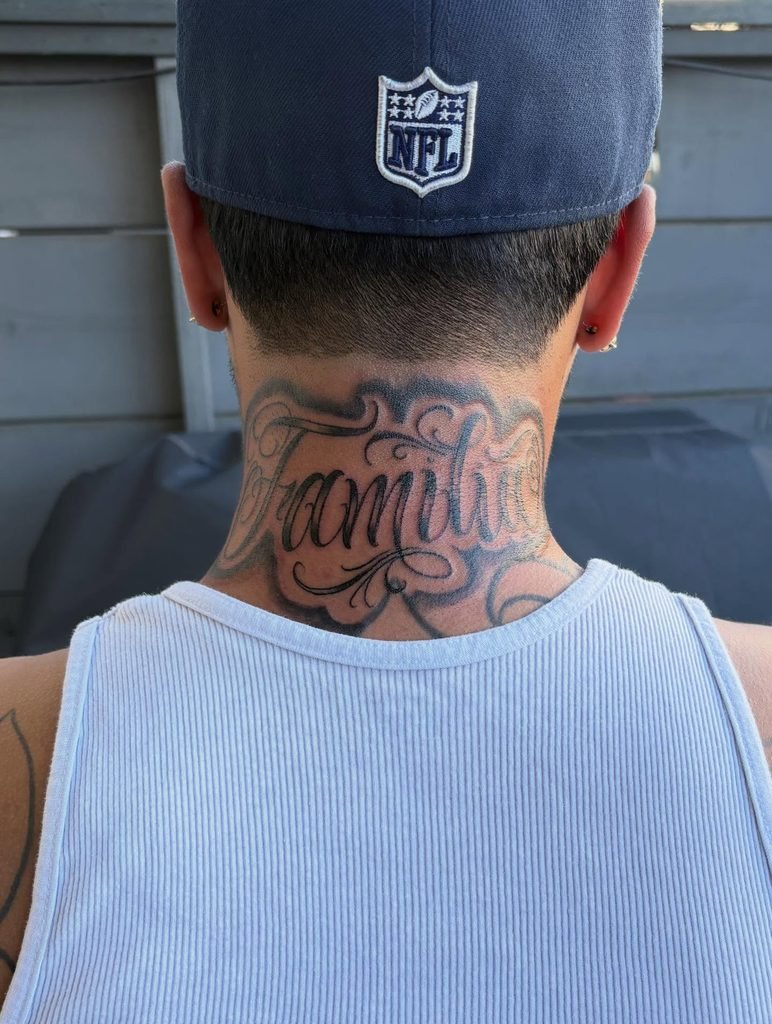
Crisp black cursive spells “Familia” horizontally across the nape of the neck. A scalloped, diffuse shadow border surrounds the typography, building a cloud-like frame.
Encasing text within a solid border acts exactly like mounting a delicate sketch inside a heavy, dark mat board.
Free-floating words often lack structural presence on a wide physical canvas. Grounding cursive script with a distinct shaded boundary forces the eye directly to the center.
19. Trailing Botanical Vines With Minimalist Collar Text
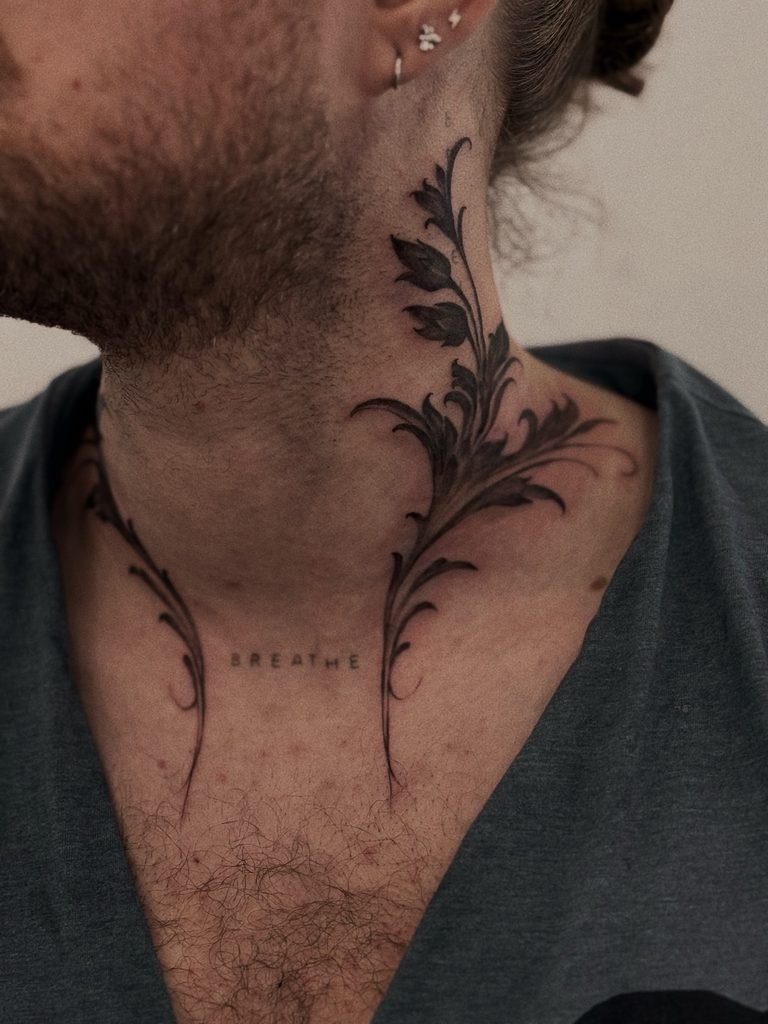
Delicate black botanical vines climb fluidly up the side of the neck, branching into soft, organic leaf shapes. Slender curved stems frame the collarbone, creating a balanced, breathable composition.
Pairing minimalist typography with trailing botanical elements adds gentle movement like hanging delicate trailing plants above a minimalist window frame.
Grounding soft text with organic vine patterns prevents the piece from looking too clinical. Men wanting a meaningful focal point without aggressive dark shading will find this open, airy design hits the ideal note.
Quick Styling Tips
- Budget version: Focus solely on the central word and a single short vine to minimize session length.
- Pro tip: Wear crewneck garments to easily conceal the collar lettering when necessary.
- Pro move: Keep the lettering lines ultra-fine so they age gracefully alongside the softer botanical shading.
Neck Tattoo Placements Explained
- Side of the neck: the most popular spot, from behind the ear down toward the collarbone. Good for script, small symbols and vertical designs.
- Throat: the front of the neck suits symmetrical pieces like wings, wreaths or ornamental designs. It is very visible and usually one of the more sensitive areas.
- Back of the neck: the nape is easier to cover with a collar or longer hair, which makes it a common first neck tattoo.
- Full collar: a design that wraps from throat to nape. It often connects to chest or shoulder work and is best planned as part of a bigger piece.
Before You Get a Neck Tattoo
Think honestly about visibility at work and in daily life, since most shirts won’t cover the side or front of the neck. Many men start at the back of the neck or extend an existing chest or shoulder piece upward. During healing, loose collars help avoid rubbing, and your artist’s aftercare advice matters more than usual because the area moves constantly.
Frequently Asked Questions
Do neck tattoos hurt?
The front of the throat and areas close to the spine tend to be more sensitive, while the side of the neck is often more manageable. Pain varies a lot from person to person, so plan shorter sessions for bigger pieces.
Are neck tattoos OK for work?
It depends on your workplace. Neck tattoos are more accepted than they used to be, but they are still harder to cover than most placements. The back of the neck is the safest choice if you sometimes need to hide your ink.
How long does a neck tattoo take to heal?
The surface usually settles within a few weeks, with full healing taking longer underneath. Keep it clean, avoid tight collars and direct sun, and follow your artist’s aftercare instructions.